US Trade Deficit Reaches $1.2 Trillion in 2025 Amid Record AI Imports and Broad Tariffs
Updated (12 articles)
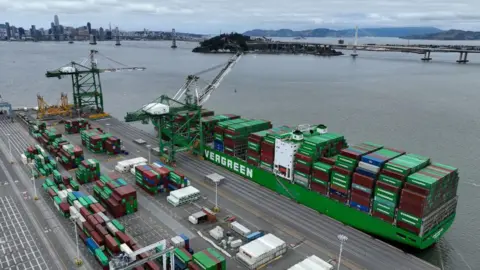
Deficit expands 2.1% to $1.2 trillion in 2025 The Bureau of Economic Analysis reports the overall trade gap grew 2.1% from 2024, reaching roughly $1.2 trillion (£890 bn) for the year, while the combined goods‑and‑services deficit held steady at $901.5 bn, barely off the $903.5 bn level recorded in 2024 [1].
Imports hit record $3.4 trillion, fueled by AI equipment Imports surged to a historic $3.4 trillion, driven largely by heightened demand for computer parts and other hardware tied to domestic artificial‑intelligence investment programs [1]. Analysts note that despite sweeping tariffs, import growth remained modest but still set a new high [1].
Exports rise yet food and auto shipments fall Export volumes reached a new peak, but shipments of U.S. food, automobiles and auto parts declined, offsetting some of the export gains and contributing to the near‑flat overall deficit [1].
China trade drops 30% to $202.1 bn, smallest in two decades Bilateral trade with China fell sharply, cutting the deficit with that partner by roughly a third to $202.1 bn, the lowest level in twenty years, while deficits with Mexico, Vietnam and Taiwan expanded to record levels [1].
Trump’s 2025 tariffs cover nearly every country, Iran duties added The administration imposed tariffs of at least 10% on almost all trading partners, issued an executive order adding duties on nations trading with Iran, and now faces a Supreme Court challenge that could overturn many of last year’s measures [1].
Analysts warn of delayed supply‑chain impacts and policy uncertainty Wells Fargo observes that import growth persists despite tariffs, JP Morgan Chase Institute predicts broader effects may surface later, and a toymaker warned “you cannot go to sleep on this president,” highlighting business‑sector concerns about the tariff regime [1].
Related Tickers
Timeline
2025 – The Trump administration imposes sweeping tariffs on ≥10 % of imports from almost every country, adds new duties on nations trading with Iran, and faces a looming Supreme Court challenge that could overturn many of the measures [1].
2025 (first 11 months) – China’s trade surplus tops $1 trillion for the first time as exports rise 5.7 % YoY, driven by Europe, Southeast Asia and Africa, while shipments to the United States plunge 18‑29 % and a diversification strategy offsets tariff pressure [6][7][11].
Oct 2025 – The United States and China reach a year‑long truce in South Korea; the U.S. lowers tariffs on Chinese goods and China pledges to halt export controls on rare‑earth minerals, easing but not ending trade tensions [7][11].
2025 – China posts a record $1.2 trillion trade surplus, its first above $1 trillion, as high‑tech, green‑tech and AI‑related exports surge 13‑27 % while imports barely grow; exports to the United States fall about 20 % and the property sector remains in deep slump [2][3][4][5][8][9].
Dec 9 2025 – Premier Li Qiang tells IMF, World Bank and WTO officials that U.S. tariffs deliver a “severe blow” to the world economy, cites the $1 trillion‑plus surplus and urges “collaborative innovation” and freer trade [10].
Jan 4 2026 – Beijing rolls out the 15th Five‑Year Plan (2026‑30), doubling down on technological self‑reliance, whole‑chain manufacturing breakthroughs and export‑led growth while domestic demand stays weak; the PLA advances its modernization and early‑warning strike doctrine [12].
Jan 14 2026 – China confirms a $1.2 trillion trade surplus, notes a 19.5 % drop in U.S. shipments, highlights a 13 % rise in high‑tech exports and a 27 % jump in EV‑related goods, and flags the October truce and possible new Iran‑related duties as future tariff dynamics [5][9].
Jan 15 2026 – Analysts stress that the surplus reflects China’s pivot to emerging markets in Southeast Asia, Africa and Latin America, while warning that heavy reliance on external demand could mask domestic weakness [4].
Jan 19 2026 – China’s 2025 economy expands 5 % in line with its target; fourth‑quarter growth slows to 4.5 %, the record $1.2 trillion surplus cushions the slowdown, and Deutsche Bank projects 4.5 % growth for 2026 [8][2].
Feb 19 2026 – The United States records a $1.2 trillion trade deficit for 2025, imports hit a record $3.4 trillion fueled by AI‑related equipment, China‑U.S. trade drops 30 % to a two‑decade low, and Trump’s 2025 tariffs now cover nearly every trading partner as the Supreme Court case looms [1].
2026 (future) – The pending Supreme Court ruling on the 2025 tariffs could reshape U.S. trade policy; the IMF urges China to rebalance toward domestic consumption; and policymakers prepare the Central Economic Work Conference’s 2026‑2030 plan to sustain manufacturing strength while boosting internal demand [10][8][9].
Dive deeper (7 sub-stories)
-
BBC: US Trade Deficit Hits $1.2 Trillion as Broad Tariffs Persist
-
China’s 2025 Growth Hits 5% as Export‑Driven Trade Surplus Offsets Domestic Weakness
(2 articles)
-
China Records $1.2 Trillion 2025 Trade Surplus as Exports Pivot From U.S.
(4 articles)
-
BBC: China reports record 2025 trade surplus despite tariffs
-
The Hindu: China’s 2026 posture blends domestic tightening with global assertiveness
-
AP: Chinese premier cites damage from US tariffs, as China’s surplus surpasses $1 trillion
-
China’s November Export Surge Drives 11‑Month Trade Surplus Past $1 Trillion
(2 articles)
All related articles (12 articles)
-
BBC: US Trade Deficit Hits $1.2 Trillion as Broad Tariffs Persist
-
AP: China’s 2025 economy expands 5% as exports buoy growth
-
BBC: China hits 5% growth as exports defy tariffs
-
CNN: China posts a record $1.2 trillion trade surplus amid US frictions, signaling resilience and risk
-
AP: China posts record 2025 trade surplus near $1.2 trillion as exports diversify beyond the U.S.
-
CNN: China posts record $1.2 trillion trade surplus as exports diversify beyond the US
-
BBC: China reports record 2025 trade surplus despite tariffs
-
The Hindu: China’s 2026 posture blends domestic tightening with global assertiveness
-
CNN: China Achieves Record $1 Trillion Trade Surplus Amid U.S. Tariffs
-
AP: Chinese premier cites damage from US tariffs, as China’s surplus surpasses $1 trillion
-
AP: China’s exports rebound to push trade surplus past $1 trillion in November
-
CNN: China’s 11-month trade surplus tops $1 trillion as November exports rebound
External resources (6 links)
- http://www.news.cn/20251208/9b2928324e694d4c8145e36d2185c1c1/c.html (cited 1 times)
- http://www.news.cn/politics/leaders/20251208/eecaa44682a942b9a2e4929cca876373/c.html (cited 1 times)
- http://www.customs.gov.cn/customs/302249/zfxxgk/2799825/302274/302275/6868550/index.html (cited 1 times)
- http://www.customs.gov.cn/customs/302249/zfxxgk/2799825/302274/302275/6868590/index.html (cited 1 times)
- https://mp.weixin.qq.com/s/atebtH2kKsAxPmL6AIEj-Q (cited 1 times)
- https://www.lesechos.fr/monde/europe/la-chine-vient-percuter-le-coeur-du-modele-industriel-europeen-previent-emmanuel-macron-2203223 (cited 1 times)