India’s AI Impact Summit Concludes with 89‑Nation Declaration Amid Infrastructure Hurdles
Updated (12 articles)
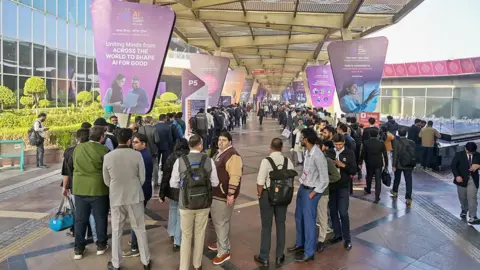
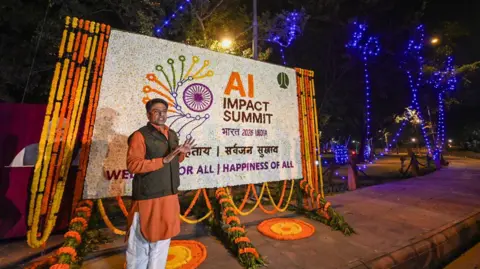
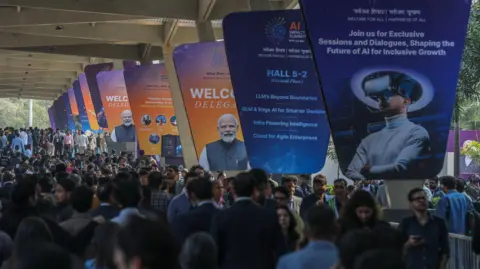
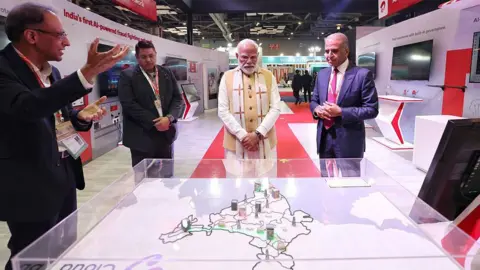
Delhi Summit Draws Over 100 Nations, Faces Opening‑Day Chaos The AI Impact Summit opened on 17 February 2026 at Bharat Mandapam, Delhi, drawing roughly 70,000 delegates from more than 100 countries [11][10]. Prime Minister Narendra Modi inaugurated the five‑day event, while tech leaders such as Sam Altman (OpenAI) and Sundar Pichai (Alphabet) attended [3][11]. Logistical failures on the first day—long queues, cash‑only food stalls, and stolen wearable devices—prompted IT Minister Ashwini Vaishnaw to apologize and activate a “war‑room” response team [11]. Despite the chaos, sessions on AI applications and policy drew praise, and the Indian Army showcased an indigenous dual‑use AI suite [9]. The summit’s momentum continued through 24 February, when editorial coverage summarized its outcomes [1].
Voluntary AI Democratization Declaration Signed by Majority of Attendees The summit concluded with a voluntary AI democratization declaration, reportedly signed by 89 countries, committing to share knowledge and close the inference gap [1]. Union IT Minister Ashwini Vaishnaw earlier indicated that more than 70 nations had already signed and expected the tally to exceed 80 by the summit’s end [3]. The discrepancy between the 89 signatures and the “over 70” figure reflects rapid final‑day sign‑ups, making the declaration the broadest multilateral AI‑governance pledge to date [1][3].
India Proposes “Third Way” Governance and Non‑Binding Military AI Norms India introduced a “Third Way” AI‑governance model that positions the country between the EU’s compliance‑heavy regime, the US’s hands‑off stance, and China’s state‑centric approach, emphasizing adoption, diffusion, diplomacy, and capacity‑building [8]. Concurrently, New Delhi advocated a non‑binding, accountability‑based framework for military AI, abstaining from the REAIM “Pathways to Action” declaration and proposing safeguards such as banning AI‑augmented autonomous nuclear decision‑making [7]. The summit also highlighted a human‑centred AI agenda aligned with World Day of Social Justice, calling for inclusive policies that protect workers while fostering innovation [6].
Infrastructure Costs and Foreign Capital Pose Deployment Challenges Summit analysts warned that India’s AI rollout faces steep hurdles: rising GPU prices, dependence on foreign‑owned capital, and the need for additional electrical capacity to power expanding data‑centre clusters [1][6]. While domestic data‑centre capacity is growing, the strategy leans toward model deployment rather than in‑house training and fine‑tuning, raising concerns about long‑term self‑reliance [1]. These infrastructure constraints are cited as key obstacles to achieving the democratization goals outlined in the declaration [1][6].
IMF and OECD Forecast AI‑Driven Growth and Job Shifts IMF Managing Director Kristalina Georgieva projected that AI could add 0.8 % to global GDP, helping India achieve its “Viksit Bharat” vision, but cautioned about job displacement risks [3]. The OECD warned that 27 % of occupations face high automation risk, urging modular upskilling for adults [3]. Indian analysts estimate AI could create over 3 million new technology jobs by 2030 and reshape more than 10 million existing roles, supported by initiatives such as the AI Mission and partnerships with the ILO [6]. These projections underscore the summit’s focus on balancing economic gains with social‑justice safeguards [3][6].
Sources
-
1.
The Hindu: India’s AI Impact Summit Highlights Enthusiasm and Strategic Challenges: reports massive Indian enthusiasm, 89‑nation declaration, infrastructure hurdles, and criticism of U.S. hands‑off stance .
-
2.
The Hindu: PM Modi Warns of Digital Arrest Scams and Touts AI, Sports, and Farming Milestones: details Modi’s Mann Ki Baat on 22 Feb 2026, AI demos at Amul booth, and warnings about KYC scams .
-
3.
The Hindu: India AI Impact Summit Sees Record‑High Global Sign‑Ups and Key Policy Pledges: notes >70 signatories, IMF and OECD comments, BLUE startup demo, meetings with Sam Altman, and youth protest arrests .
-
4.
The Hindu: Satire Piece Portrays “Saltman” Praising India at AI Impact Summit 2026: presents a fictional interview praising India’s AI future, explicitly labeled satire, not factual reporting .
-
5.
The Hindu: Experts Call for Social Good, Guardrails and Governance at 2026 AI Impact Summit: compiles five editorials urging AI for societal benefit, defense safeguards, and governance frameworks .
-
6.
The Hindu: India Pushes Human‑Centred AI at Impact Summit, Cites Job Growth and Social‑Protection Goals: highlights human‑centred AI, ChatGPT usage, ILO partnership, e‑Shram expansion, and AI Mission initiatives .
-
7.
The Hindu: India’s Push for a Non‑Binding Military AI Framework After REAIM Abstention: explains India’s abstention from REAIM, preference for flexible accountability‑based norms, and proposed safeguards for lethal autonomous weapons .
-
8.
The Hindu: India Positions “Third Way” AI Governance at Delhi Summit: outlines India’s distinct governance model, November 2025 guidelines, February 10 amendment for AI‑generated content labeling, and emphasis on Global South collaboration .
-
9.
The Hindu: Indian Army Showcases Homegrown Dual‑Use AI at India AI Summit: describes Army’s indigenous AI suite, dual‑use platforms for defence and disaster management, and focus on self‑reliance .
-
10.
BBC: India’s AI Impact Summit Highlights Global‑South Shift and Ongoing Inequities: reports summit’s global‑tech leadership, Bill Gates keynote, low‑paid data workers, language gaps, sovereign AI platform funding, and safety‑outcome skepticism .
-
11.
BBC: India’s AI Impact Summit Marred by Logistical Chaos on Opening Day: details long queues, service shortfalls, Modi inauguration, IT Minister Vaishnaw apology, and war‑room response .
Related Tickers
Timeline
Nov 2025 – India releases “Third Way” AI governance guidelines that focus on adoption, diffusion, diplomacy and capacity‑building, using existing legal structures and an agile framework to scale AI for inclusive health, agriculture, education and public administration [8].
Dec 29, 2025 – The Union government announces the AI Impact Summit will match G20‑scale participation, expecting 15‑20 heads of state and ~100,000 attendees, with over 300 pre‑summit events already held to signal India’s intent to shape global AI policy and include the Global South [12].
Feb 10, 2026 – India amends the IT (Intermediary Guidelines and Digital Media Ethics Code) Rules, mandating platforms to label AI‑generated content and remove harmful material within three hours, the first compulsory AI‑disclosure requirement [8].
Feb 17, 2026 – Prime Minister Narendra Modi inaugurates the first Global‑South AI Impact Summit at Bharat Mandapam; opening‑day chaos produces long queues, cash‑only food stalls and stolen wearables, prompting IT Minister Ashwini Vaishnaw to apologise and launch a “war‑room,” calling the organisation “very slow” [2].
Feb 17, 2026 – The Indian Army showcases an indigenous dual‑use AI suite—including AI Examiner, SAM‑UN, EKAM, PRAKSHEPAN, XFace and deep‑fake detection—highlighting self‑reliance, disaster‑resilience and civilian applications such as flood warnings [11].
Feb 18, 2026 – India puts forward a “Third Way” AI governance model distinct from EU, US and China, leveraging its size and digital diffusion to promote strategic autonomy, public‑private partnerships and agile collective standards for the Global South, with the next 12 months set to test its balance of innovation and security [8].
Feb 18, 2026 – India abstains from the REAIM “Pathways to Action” military AI declaration, deeming binding LAWS rules “premature” and advocating a flexible, accountability‑based framework that bans AI‑augmented autonomous nuclear decision‑making and encourages voluntary confidence‑building data exchanges [9].
Feb 18, 2026 – On World Day of Social Justice, the summit frames its agenda around human‑centred AI; India leads in ChatGPT usage and forecasts AI could create >3 million new technology jobs by 2030, while the ILO‑backed e‑Shram platform now covers 64.3 % of informal workers, boosted by Microsoft’s $17.5 billion AI investment [10].
Feb 19, 2026 – Experts publish opinion pieces urging guardrails for military AI and social‑good governance, stressing the need for clear defence safeguards and inclusive policy frameworks [7].
Feb 19, 2026 – A satirical “Saltman” interview appears in The Hindu, humorously proclaiming India the “greatest country” and outlining six AI layers, underscoring the summit’s cultural resonance despite its fictional nature [5].
Feb 20, 2026 – Over 70 nations have signed the AI Impact Summit declaration, with expectations to exceed 80 signatories, marking the broadest multilateral AI‑governance commitment; IMF Managing Director Kristalina Georgieva warns AI could add 0.8 % to global growth but also pose job‑loss risks, urging balanced policy [4].
Feb 20, 2026 – Prime Minister Modi meets OpenAI CEO Sam Altman and Qualcomm CEO Cristiano Amon, touting sovereign AI for agriculture, environment and education, while Altman praises India’s rapid AI adoption and sovereign infrastructure plans [4].
Feb 22, 2026 – In his Mann Ki Baat broadcast, Modi warns citizens against digital‑arrest scams and KYC fraud, stressing updates are “only for the security of your own money,” and showcases AI‑assisted livestock monitoring and ancient‑manuscript digitisation demonstrated at the summit [6].
Feb 23, 2026 – Eighty‑nine countries sign a voluntary AI democratisation declaration, committing to share knowledge and close the inference gap; observers criticize India’s alignment with the US hands‑off approach that may limit collective safety standards [3].
Feb 24, 2026 – Editorials summarise the week‑long summit, noting massive Indian enthusiasm, infrastructure and cost hurdles for AI deployment, and calling for democratising AI to avoid an inference gap, reflecting the event’s implications for India’s global AI role [3].
Dive deeper (7 sub-stories)
-
India’s AI Impact Summit Draws Global Commitment, Highlights Infrastructure Hurdles
(3 articles)
-
The Hindu: PM Modi warns of digital arrest scams and touts AI, sports, and farming milestones
-
India’s AI Impact Summit Secures 70+ International Sign‑Ons, Announces Sovereign AI Plans, Youth Arrests
(3 articles)
-
The Hindu: Satire Piece Portrays “Saltman” Praising India at AI Impact Summit 2026
-
The Hindu: Experts Call for Social Good, Guardrails and Governance at 2026 AI Impact Summit
-
The Hindu: Indian Army showcases homegrown dual‑use AI at India AI Summit
-
India’s AI Impact Summit Opens Chaotically, Modi Inaugurates Amid Logistical Failures
(2 articles)
All related articles (12 articles)
-
The Hindu: India’s AI Impact Summit Highlights Enthusiasm and Strategic Challenges
-
The Hindu: PM Modi warns of digital arrest scams and touts AI, sports, and farming milestones
-
The Hindu: India AI Impact Summit sees record‑high global sign‑ups and key policy pledges
-
The Hindu: Satire Piece Portrays “Saltman” Praising India at AI Impact Summit 2026
-
The Hindu: Experts Call for Social Good, Guardrails and Governance at 2026 AI Impact Summit
-
The Hindu: India pushes human‑centred AI at Impact Summit, cites job growth and social‑protection goals
-
The Hindu: India’s Push for a Non‑Binding Military AI Framework After REAIM Abstention
-
The Hindu: India Positions “Third Way” AI Governance at Delhi Summit
-
The Hindu: Indian Army showcases homegrown dual‑use AI at India AI Summit
-
BBC: India’s AI Impact Summit Highlights Global‑South Shift and Ongoing Inequities
-
BBC: India's AI Impact Summit Marred by Logistical Chaos on Opening Day
-
The Hindu: India eyes G20-level participation for AI Impact Summit in February
External resources (3 links)
- https://t.co/fmO9bV0vwV (cited 1 times)
- https://twitter.com/hashtag/IndianArmy?src=hash&ref_src=twsrc%5Etfw (cited 1 times)