U.S. Deploys Two Carriers Near Iran While Planning Syrian Troop Withdrawal
Updated (21 articles)

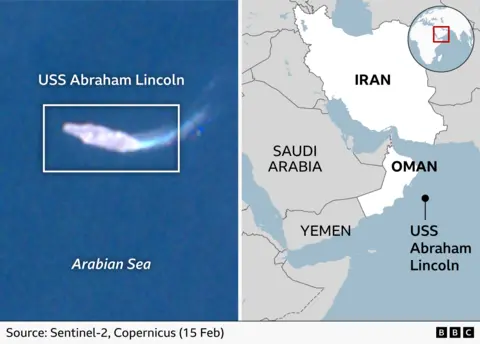
Carrier Deployment Intensifies U.S. Presence Near Iran The Navy positioned the USS Abraham Lincoln within striking distance of Iranian waters and scheduled the world’s largest carrier, USS Gerald R Ford, to arrive within three weeks, bringing a full carrier strike group to the region by mid‑March[1][2]. Iran’s Islamic Revolutionary Guard Corps responded with a maritime drill in the Strait of Hormuz, underscoring heightened tension[1]. Both articles note that the carrier buildup follows a broader U.S. naval expansion near Iran[1][2].
Trump Considers Military Action Against Iran President Trump discussed strike options with advisers and signaled that an attack could occur as early as Saturday, though officials described the decision as fluid and not final[1][2]. Media reports linked the possible strike to the newly deployed carriers, suggesting a rapid escalation if diplomatic talks stall[1]. No definitive order has been issued, and the administration continues to press Iran toward a negotiated settlement[1].
U.S. Announces Large‑Scale Syrian Troop Pullout senior White House official confirmed that the United States will withdraw roughly 1,000 remaining troops from Syria over the coming months, shifting counter‑terrorism responsibilities to the Syrian government[2]. The drawdown follows earlier closures of the al‑Tanf and al‑Shaddadi bases and reflects improved security conditions after the 2024 Assad regime collapse and ISIS decline[2]. The pullout is condition‑based, with the U.S. retaining the ability to respond to regional threats while reducing its footprint[2].
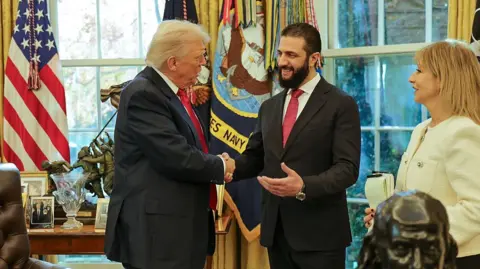
Diplomatic Overtures Accompany Military Shifts Geneva talks produced limited progress, with Iran claiming an understanding on “guiding principles” for its nuclear program but both sides remaining far apart on key issues[1]. Supreme Leader Ayatollah Ali Khamenei posted an AI‑generated image of the USS Gerald R Ford sunk, framing U.S. naval power as a pretext for forced negotiations[1]. Meanwhile, Syrian President Ahmed al‑Sharaa visited the White House and Secretary of State Marco Rubio met Syrian officials to discuss ceasefire and terrorism concerns, highlighting parallel diplomatic efforts[2].
Sources
-
1.
BBC: White House Presses Iran to Negotiate as U.S. Warships Deploy: Details carrier positioning, Trump’s strike deliberations, Iran’s IRGC drill, Khamenei’s AI image, and limited Geneva progress, emphasizing diplomatic pressure alongside military buildup.
-
2.
BBC: U.S. Plans Large‑Scale Troop Pullout from Syria Amid Rising Iran Tensions: Outlines the planned Syrian troop withdrawal, carrier deployments, Trump’s possible Saturday strike, earlier base closures, and recent diplomatic engagements with Syrian leaders, linking the pullout to shifting regional security dynamics.
Related Tickers
Timeline
2024 – The collapse of the Assad regime prompts the United States to close the al‑Tanf and al‑Shaddadi bases, laying groundwork for a later large‑scale Syrian troop pullout. [2]
June 2025 – U.S. B‑2 stealth bombers launch a 37‑hour mission from Missouri, striking three Iranian nuclear sites in the most extensive direct attack on Iran’s program to date. [4]
Jan 21, 2026 – Iran’s foreign minister Abbas Araghchi warns in a Wall Street Journal op‑ed that Tehran will respond with overwhelming force if attacked, as the USS Abraham Lincoln carrier strike group transits the Strait of Malacca and U.S. F‑15E fighters and a HIMARS system are repositioned to the region. [15]
Jan 21, 2026 – President Donald Trump tells NewsNation he will “wipe the Iranian regime off the face of the Earth” if Tehran strikes, while U.S. jets land in Jordan, the carrier moves toward the Gulf, and Patriot and THAAD air‑defense batteries are slated for deployment. [16]
Jan 23, 2026 – The United States moves the USS Abraham Lincoln and other warships toward the Middle East; Trump declares an “armada” heading to Iran and claims he stopped 837 executions, a claim Iran’s top prosecutor rejects, and protest death toll estimates range from 3,117 (official) to over 5,000 (activists). [13][14][17]
Jan 24, 2026 – IRGC commander Gen. Mohammad Pakpour warns the U.S. and Israel that the Guard’s “finger is on the trigger,” as Trump announces a massive fleet in the Indian Ocean; European airlines cancel or delay Dubai flights, and the UN warns Iran may execute detained protesters amid a death toll exceeding 5,000. [20][21]
Jan 25, 2026 – Tehran unveils a giant anti‑U.S. mural in Enghelab Square showing a blood‑stained USS Abraham Lincoln with the slogan “If you sow the wind, you will reap the whirlwind,” coinciding with the carrier group’s approach. [19]
Jan 26, 2026 – The USS Abraham Lincoln carrier strike group reaches the Indian Ocean, positioning the carrier and three destroyers nearer to Iran while Trump repeats that the ships are “just in case” and frames the move as a deterrent. [7][18]
Jan 27, 2026 – Tehran posts threatening billboards in Revolution Square depicting a damaged U.S. carrier; Trump claims a “big armada” larger than the force sent to Venezuela is moving toward Iran, and the U.S. describes the carrier group as a precautionary measure. [11][12][5]
Jan 28, 2026 – Trump issues a new ultimatum on Truth Social, warning of “far worse” attacks and describing the Abraham Lincoln‑led armada as “ready, willing, and able,” while U.S. Central Command announces undisclosed multi‑day combat‑air‑power drills across its area of responsibility. [10][6]
Jan 29, 2026 – Iran announces the fielding of 1,000 strategic drones and vows “unprecedented” retaliation against U.S. assets such as Qatar’s Al Udeid Air Base; the United States conducts readiness drills throughout CENTCOM. [9]
Jan 30, 2026 – U.S. forces surge with the Lincoln Carrier Strike Group, three guided‑missile destroyers, F‑35C, F‑18 and EA‑18G aircraft, plus THAAD and Patriot batteries at Al Udeid Air Base, as a multiday combat‑power exercise begins, echoing the 2025 B‑2 strike. [4]
Feb 1, 2026 – Supreme Leader Ayatollah Ali Khamenei warns that a U.S. attack would spark a regional war; the USS Abraham Lincoln operates in the Arabian Sea, Iran’s FM Abbas Araghchi says trust in the U.S. is eroded but talks continue via regional intermediaries, and the IRGC cancels a planned live‑fire drill in the Strait of Hormuz. [3][8]
Feb 19, 2026 – White House press secretary Karoline Leavitt urges Iran to strike a deal with President Trump; the U.S. positions the USS Abraham Lincoln near Iranian waters and plans to send the world’s largest carrier, USS Gerald R Ford, within three weeks (by mid‑March); Geneva talks yield limited progress on “guiding principles,” while Iran conducts a maritime drill in the Strait of Hormuz and the Supreme Leader shares an AI‑generated image of the Gerald R Ford sinking. [1][2]
Mid‑March 2026 (planned) – The USS Gerald R Ford is expected to arrive in the region within three weeks, further expanding U.S. naval power near Iran. [1]
Coming months, 2026 (planned) – The United States will withdraw roughly 1,000 remaining troops from Syria under a conditions‑based plan, shifting counter‑terrorism responsibilities to the Syrian government. [2]
Dive deeper (19 sub-stories)
-
BBC: White House Presses Iran to Negotiate as U.S. Warships Deploy
-
BBC: U.S. Plans Large‑Scale Troop Pullout from Syria Amid Rising Iran Tensions
-
BBC: Iran’s Supreme Leader Threatens Regional War Over Possible U.S. Attack
-
Newsweek: Iran’s Supreme Leader Warns U.S. Attack Will Trigger Regional War
-
CNN: US Forces Surge in Middle East as Trump Mulls Iran Strike
-
Newsweek: Iran Deploys 1,000 Drones as U.S. Armada Moves Toward Region
-
Trump Threatens Iran as USS Abraham Lincoln Arrives, Air Drills Commence
(2 articles)
-
CNN: Tehran Braces for U.S. Naval Presence Amid Post‑Crackdown Tension
-
Newsweek: Iran Unveils Blood‑Stained Billboard Targeting U.S. Carrier Amid Rising Tensions
-
Newsweek: Trump Says U.S. Navy Deploys Large Armada Near Iran Amid Ongoing Tensions
-
U.S. Carrier Strike Group Enters Indian Ocean as Trump Mulls Iran Response
(2 articles)
-
AP: Iran’s New Anti‑US Mural Highlights Escalating Tehran‑Washington Tensions
-
King5 (Seattle, WA): Iran’s IRGC Commander Threatens US as Warships Move Toward Region
-
AP: Iran’s IRGC Commander Threatens US as Warships Approach
-
AP: U.S. Military Deploys Carrier Group to Middle East Amid Iran Unrest
-
Newsweek: Iran rejects Trump's claim of halted executions as U.S. ships move toward Iran
-
Newsweek: Trump warns of armada heading to Iran amid protests
-
Newsweek: Iran warns it will use everything it has as U.S. moves forces
-
Newsweek: Trump threatens to wipe Iran's regime off the face of the Earth as tensions rise
All related articles (21 articles)
-
BBC: White House Presses Iran to Negotiate as U.S. Warships Deploy
-
BBC: U.S. Plans Large‑Scale Troop Pullout from Syria Amid Rising Iran Tensions
-
BBC: Iran’s Supreme Leader Threatens Regional War Over Possible U.S. Attack
-
Newsweek: Iran’s Supreme Leader Warns U.S. Attack Will Trigger Regional War
-
CNN: US Forces Surge in Middle East as Trump Mulls Iran Strike
-
Newsweek: Iran Deploys 1,000 Drones as U.S. Armada Moves Toward Region
-
Newsweek: Trump Issues New Ultimatum to Iran, Threatening “Far Worse” Strikes
-
CNN: US Conducts Middle‑East Air Drills as Iran Tensions Rise
-
CNN: Tehran Braces for U.S. Naval Presence Amid Post‑Crackdown Tension
-
Newsweek: Iran Unveils Blood‑Stained Billboard Targeting U.S. Carrier Amid Rising Tensions
-
Newsweek: Trump Says U.S. Navy Deploys Large Armada Near Iran Amid Ongoing Tensions
-
CNN: USS Abraham Lincoln Carrier Strike Group Moves Into Indian Ocean Amid Rising US‑Iran Tensions
-
AP: USS Abraham Lincoln Carrier Deploys to Middle East Amid Iran Tensions
-
AP: Iran’s New Anti‑US Mural Highlights Escalating Tehran‑Washington Tensions
-
King5 (Seattle, WA): Iran’s IRGC Commander Threatens US as Warships Move Toward Region
-
AP: Iran’s IRGC Commander Threatens US as Warships Approach
-
AP: U.S. Military Deploys Carrier Group to Middle East Amid Iran Unrest
-
Newsweek: Iran rejects Trump's claim of halted executions as U.S. ships move toward Iran
-
Newsweek: Trump warns of armada heading to Iran amid protests
-
Newsweek: Iran warns it will use everything it has as U.S. moves forces
-
Newsweek: Trump threatens to wipe Iran's regime off the face of the Earth as tensions rise
External resources (12 links)
- https://x.com/defencehq/status/2014459690638344339?s=46&t=QxzOMiC4we0qkulaZlO4vg (cited 2 times)
- https://t.me/farsna/408848 (cited 1 times)
- https://x.com/CENTCOM/status/2013647979673010637 (cited 1 times)
- https://x.com/CENTCOM/status/2015815632302801143 (cited 1 times)
- https://x.com/LindseyGrahamSC/status/2015931978936103039 (cited 1 times)
- https://x.com/araghchi/status/2016568541399445735 (cited 1 times)
- https://tbg.airframes.io/ (cited 1 times)
- https://www.bing.com/ck/a?!&&p=2cddb51d14ef76e9b599de147f99bb1def9946dac9bb94a2ac8593a04478dd77JmltdHM9MTc2OTEyNjQwMA&ptn=3&ver=2&hsh=4&fclid=31294c2b-4a98-6c6c-3c6d-5ac24bca6d43&psq=Trump+Iran&u=a1aHR0cHM6Ly93d3cucmV1dGVycy5jb20vd29ybGQvbWlkZGxlLWVhc3QvdXMtbWlsaXRhcnktYXNzZXRzLWhlYWRpbmctbWlkZGxlLWVhc3QtZXZlbi10cnVtcC1iYWNrcy1vZmYtdG91Z2hlc3QtaXJhbi0yMDI2LTAxLTIyLw (cited 1 times)
- https://www.bing.com/ck/a?!&&p=2f764b001b8f718152361d90da32fc483ff7d27555ebf932b6babadc1a203aa5JmltdHM9MTc2OTEyNjQwMA&ptn=3&ver=2&hsh=4&fclid=31294c2b-4a98-6c6c-3c6d-5ac24bca6d43&psq=USS+Abraham+Newsweek&u=a1aHR0cHM6Ly93d3cubmV3c3dlZWsuY29tL3Bob3Rvcy11cy1haXJjcmFmdC1jYXJyaWVyLXdlc3QtcGFjaWZpYy1pcmFuLXRlbnNpb25zLTExMzgzOTE1 (cited 1 times)
- https://www.bing.com/ck/a?!&&p=40b3e932505231d92a99e37c323c13c7c311dfd6ea662ef346f9fea0714ff168JmltdHM9MTc2OTEyNjQwMA&ptn=3&ver=2&hsh=4&fclid=31294c2b-4a98-6c6c-3c6d-5ac24bca6d43&psq=3%2c117+people%2c+death+Iran&u=a1aHR0cHM6Ly91ay5uZXdzLnlhaG9vLmNvbS9pcmFuaWFuLXN0YXRlLXR2LWlzc3Vlcy1maXJzdC0wMzA1MTIzMDkuaHRtbA (cited 1 times)