Trump’s Net Approval Plummets to Record Low of –26 in Early February Polls
Updated (46 articles)


Four National Surveys Show Historic Negative Ratings Four major national surveys conducted from early January through early February record President Donald Trump’s net approval between ‑19 and ‑26 points, a range described by CNN chief data analyst Harry Enten as unprecedented for a second‑term president [1].
AP‑NORC AmeriSpeak Poll Records Deepest Decline The AP‑NORC AmeriSpeak poll fielded Feb 5‑8 with 1,156 adults using the University of Chicago’s probability‑based panel reported a net approval of ‑26, with a margin of error of ±3.9 percentage points [1].
NBC Decision Desk and Quinnipiac Provide Consistent Negative Views NBC’s Decision Desk poll (Jan 27‑Feb 6, 21,995 respondents) yielded a net approval of ‑22 (±2.4 pp), while Quinnipiac’s Jan 29‑Feb 2 survey of 1,191 registered voters showed 37 % approve and 56 % disapprove, a net of ‑19, down from the ‑14 rating recorded in October and mid‑January [1].
White House Defends Mandate Despite Poll Results White House spokesman Davis Ingle argued the “ultimate poll” was the Nov 5 2024 election, in which nearly 80 million Americans elected Trump, asserting the president remains the most dominant figure in American politics despite the low approval numbers [1].
Related Tickers
Videos (1)
Primary Data (7)
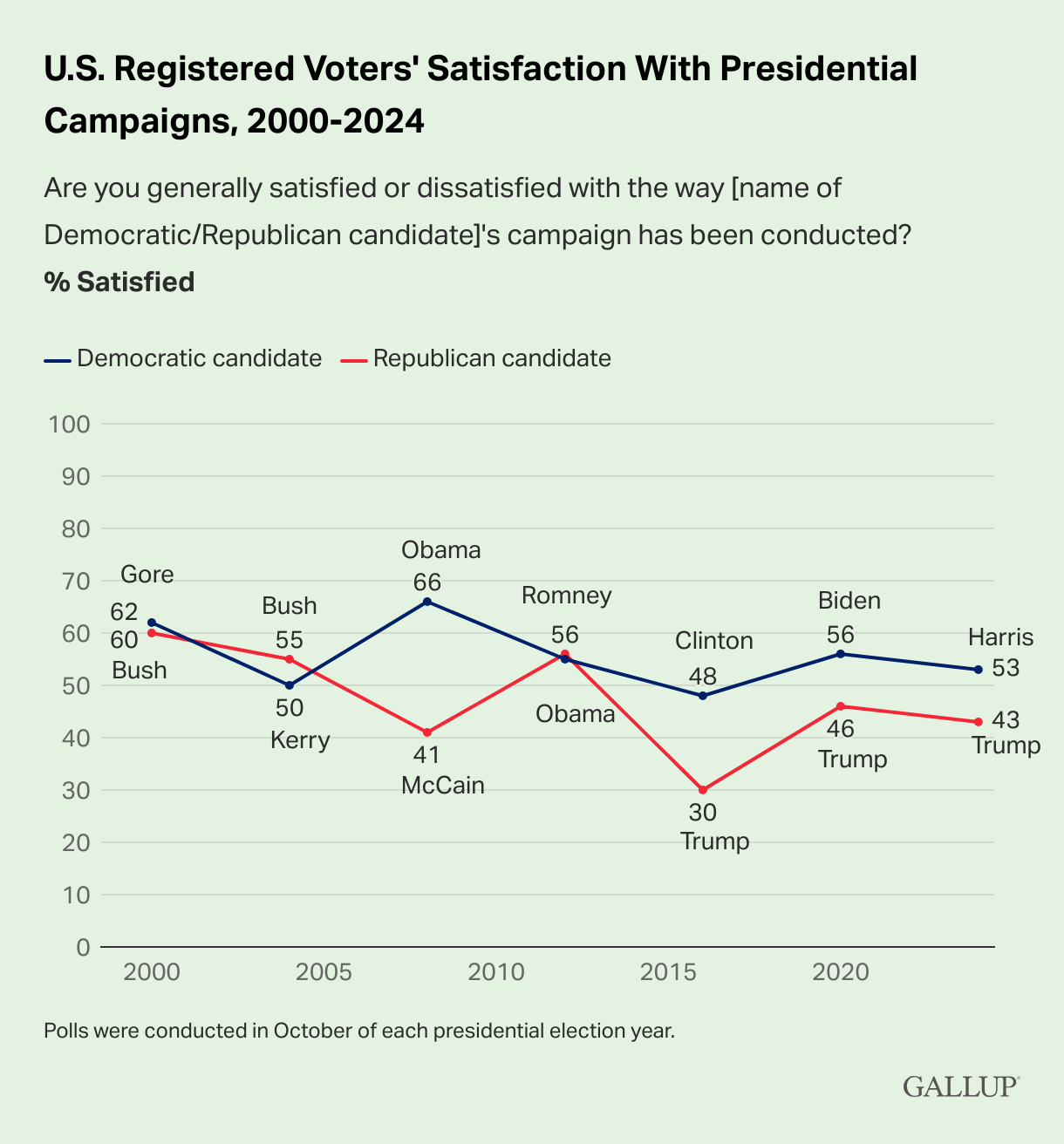
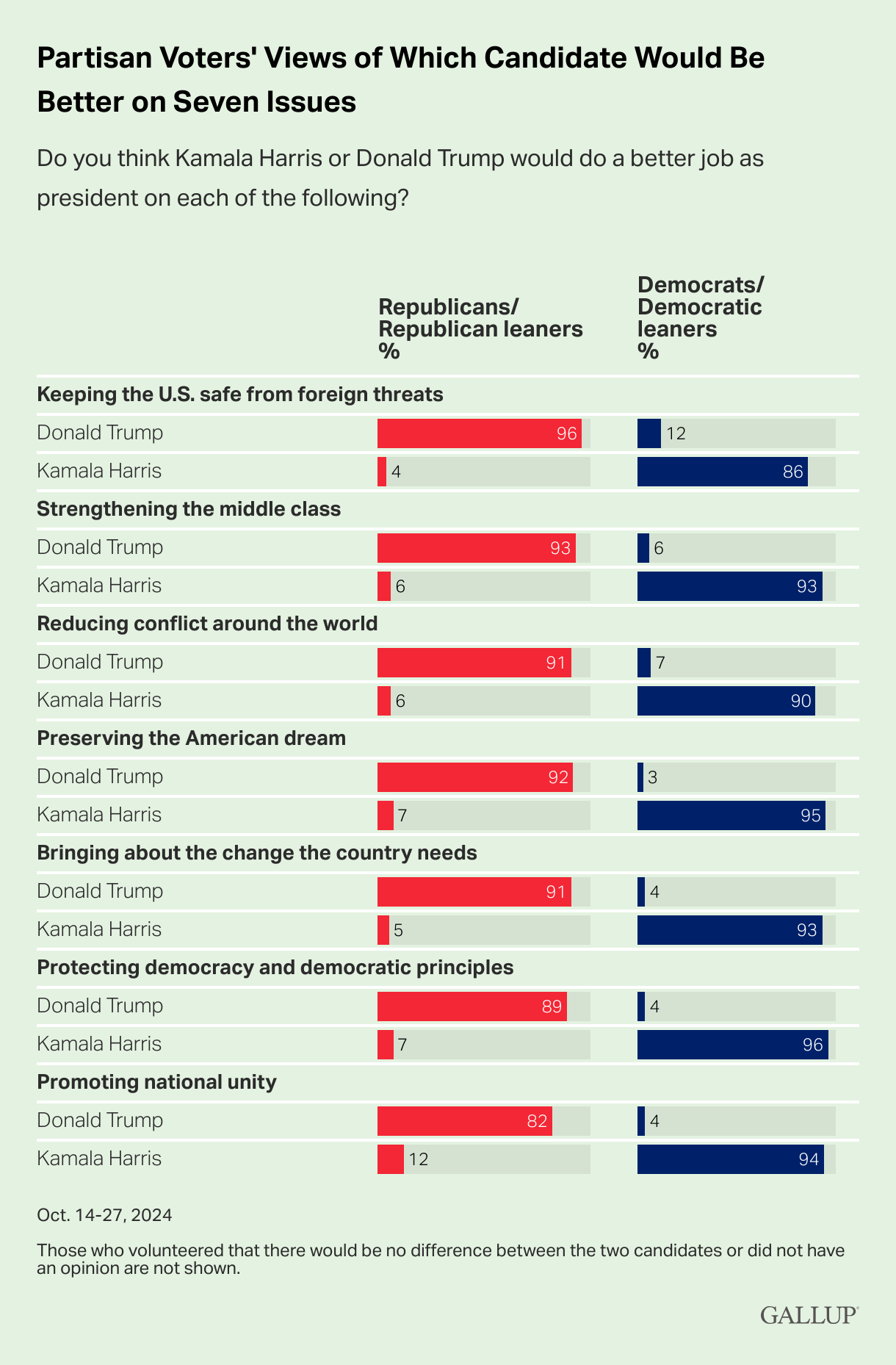
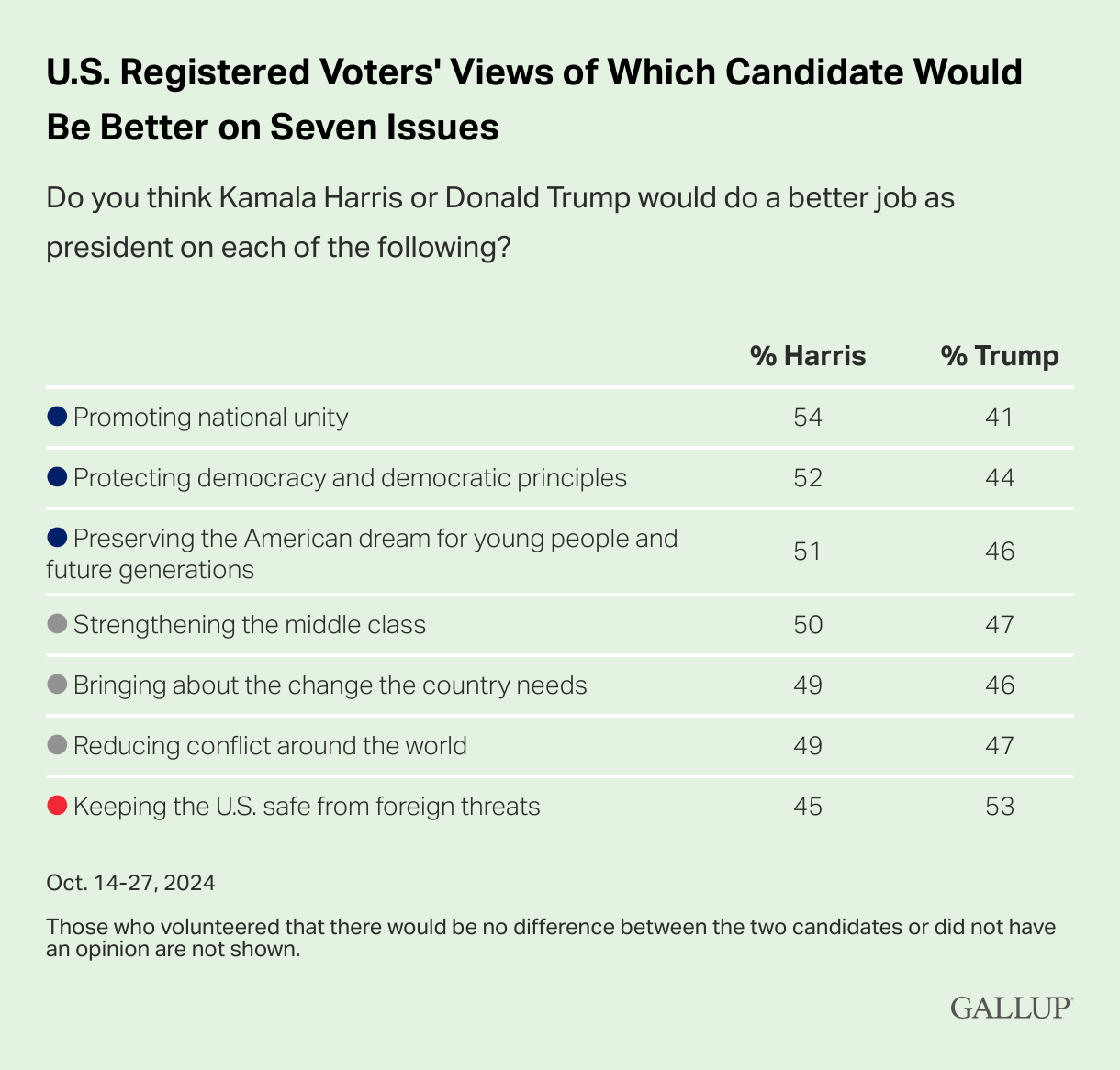
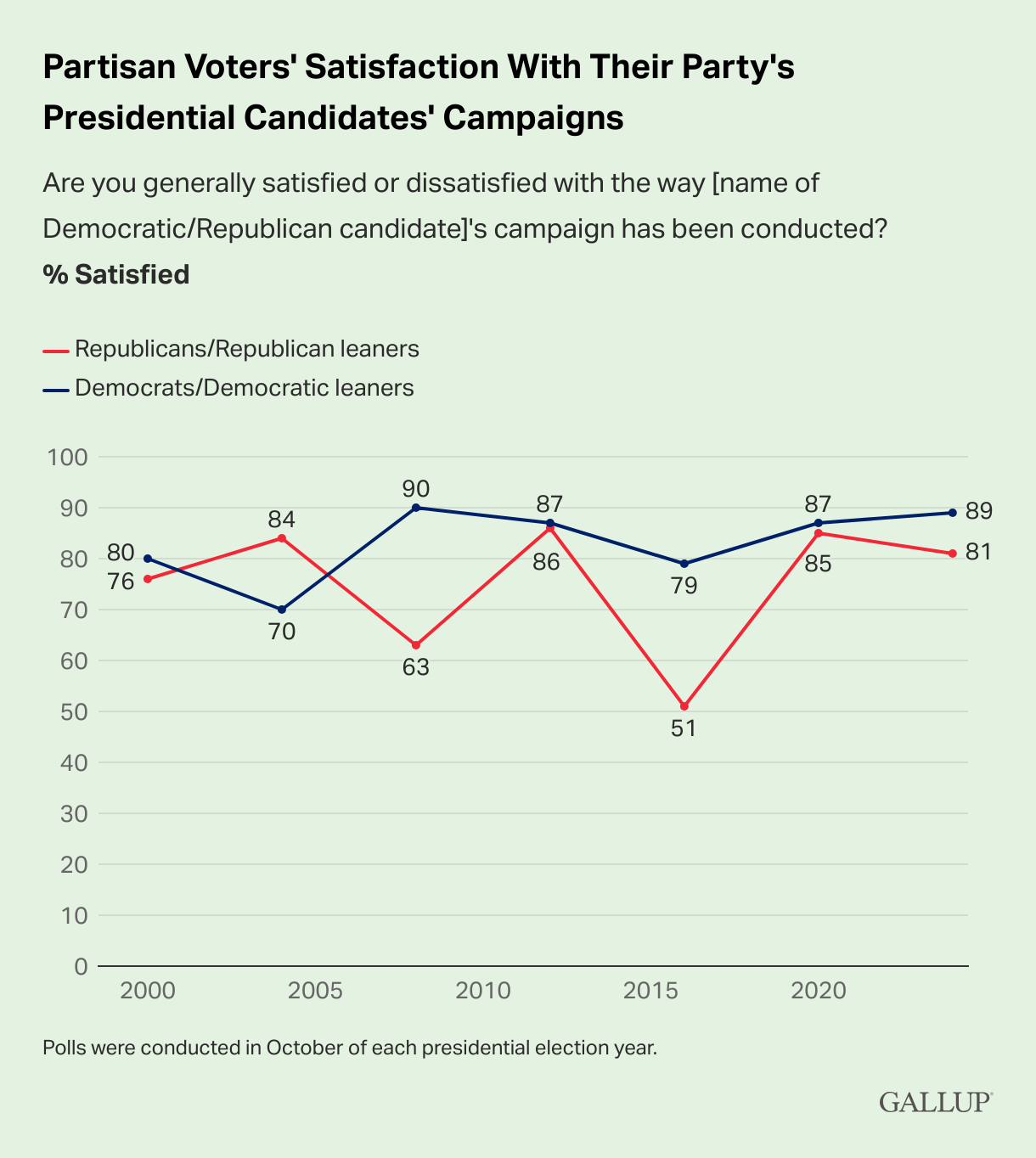
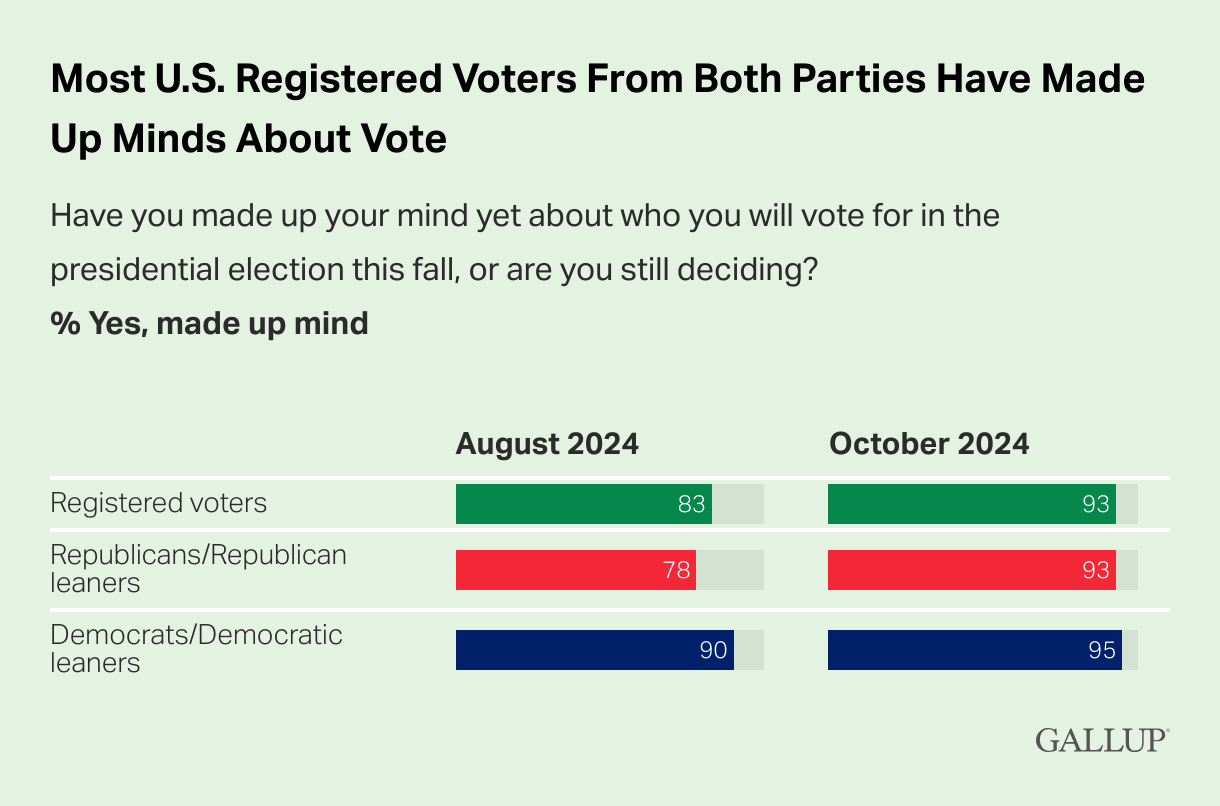
Gallup: Economy, Immigration, Abortion, Democracy Driving Voters
Published (6 tables/charts)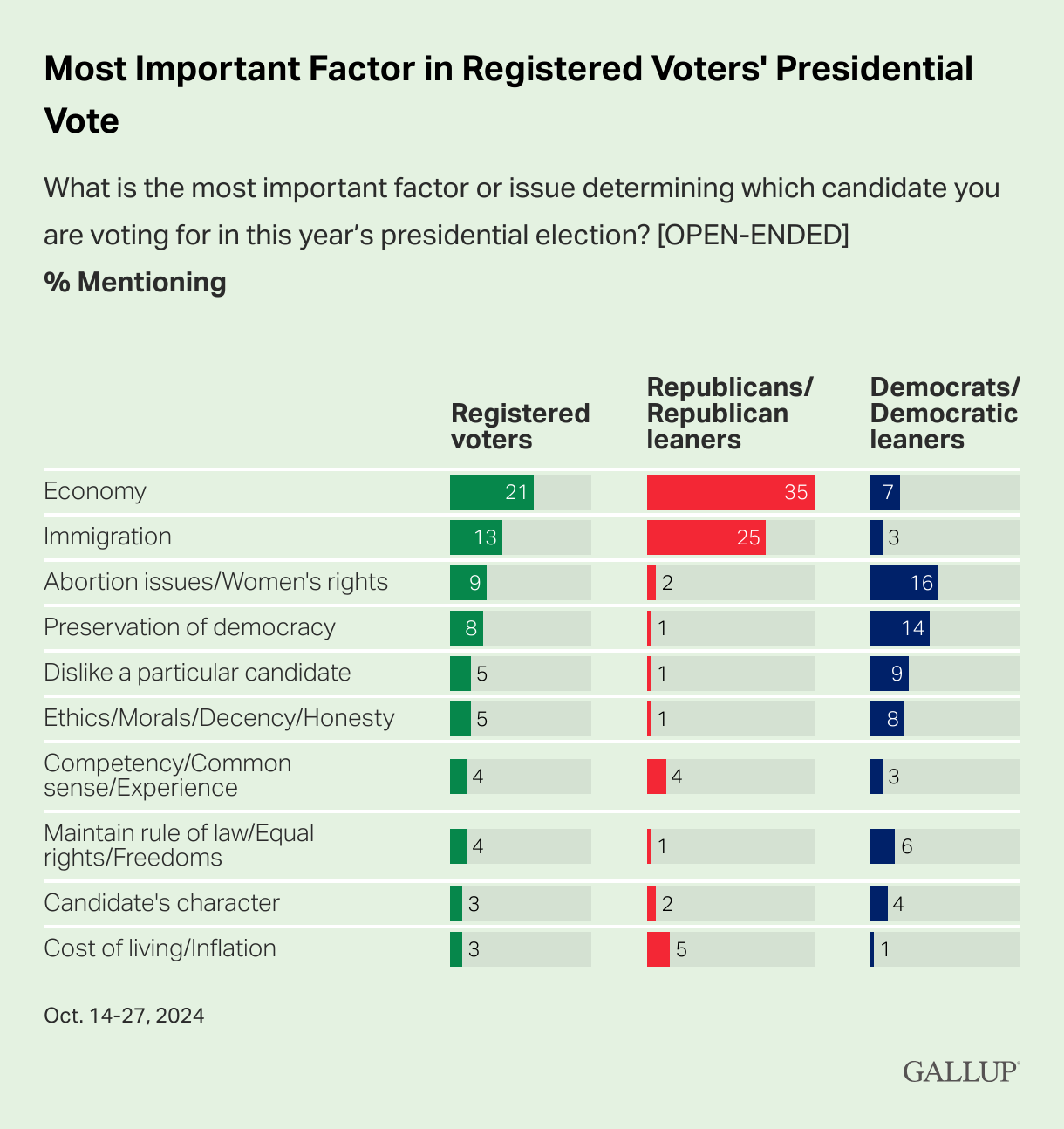
Gallup: Trump's Approval Rating Drops to 36%, New Second-Term Low
Published (6 tables/charts)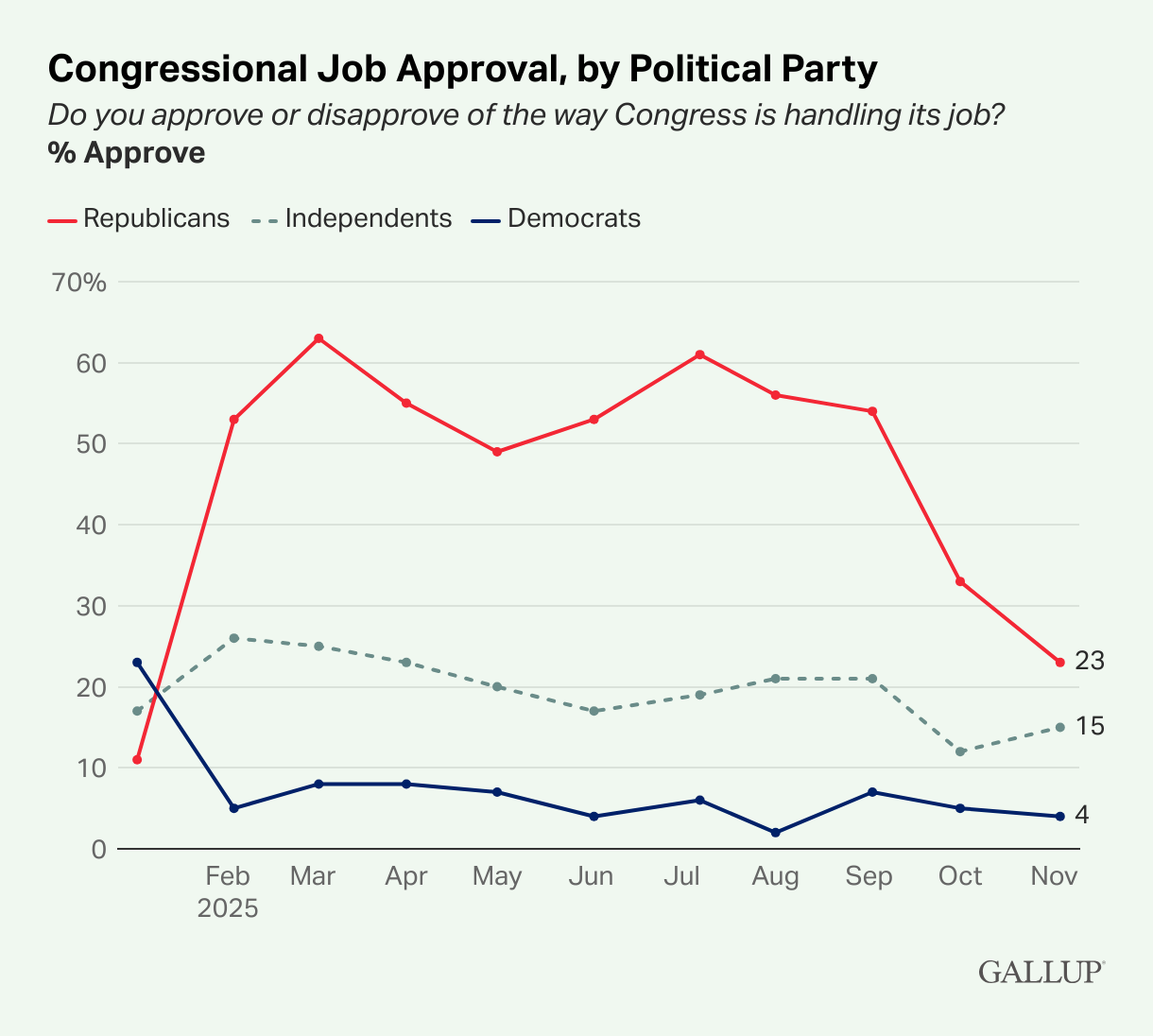
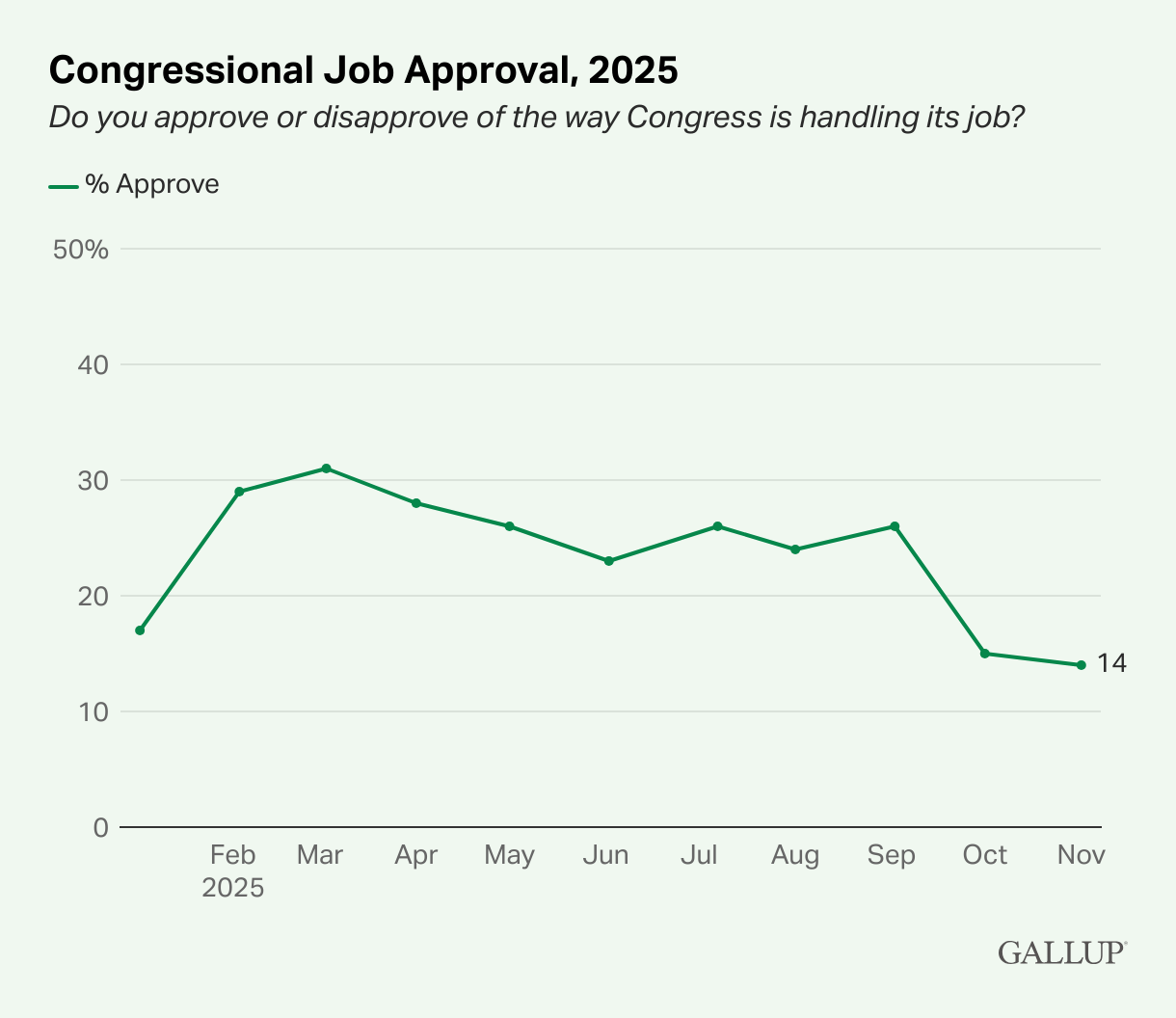
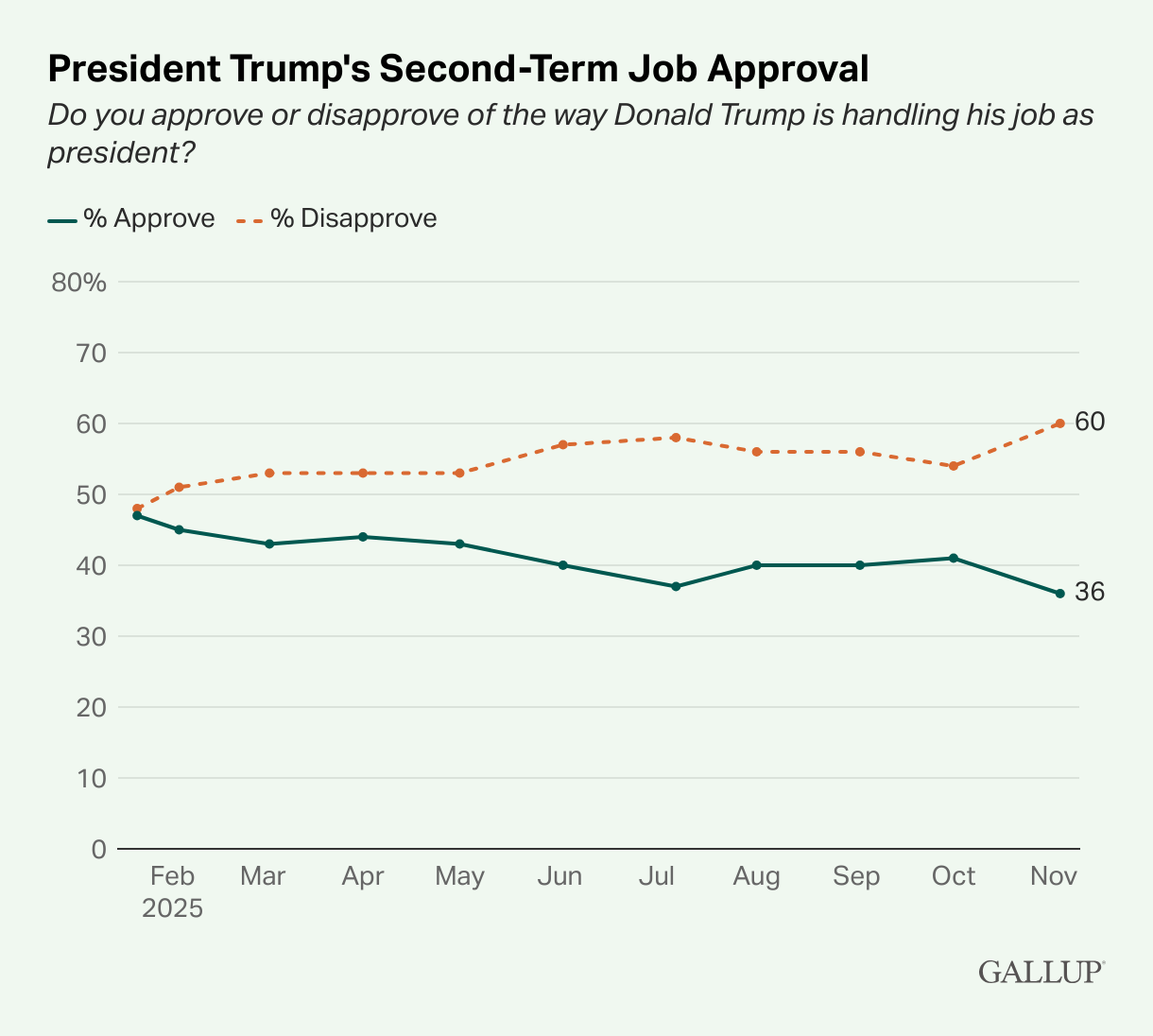
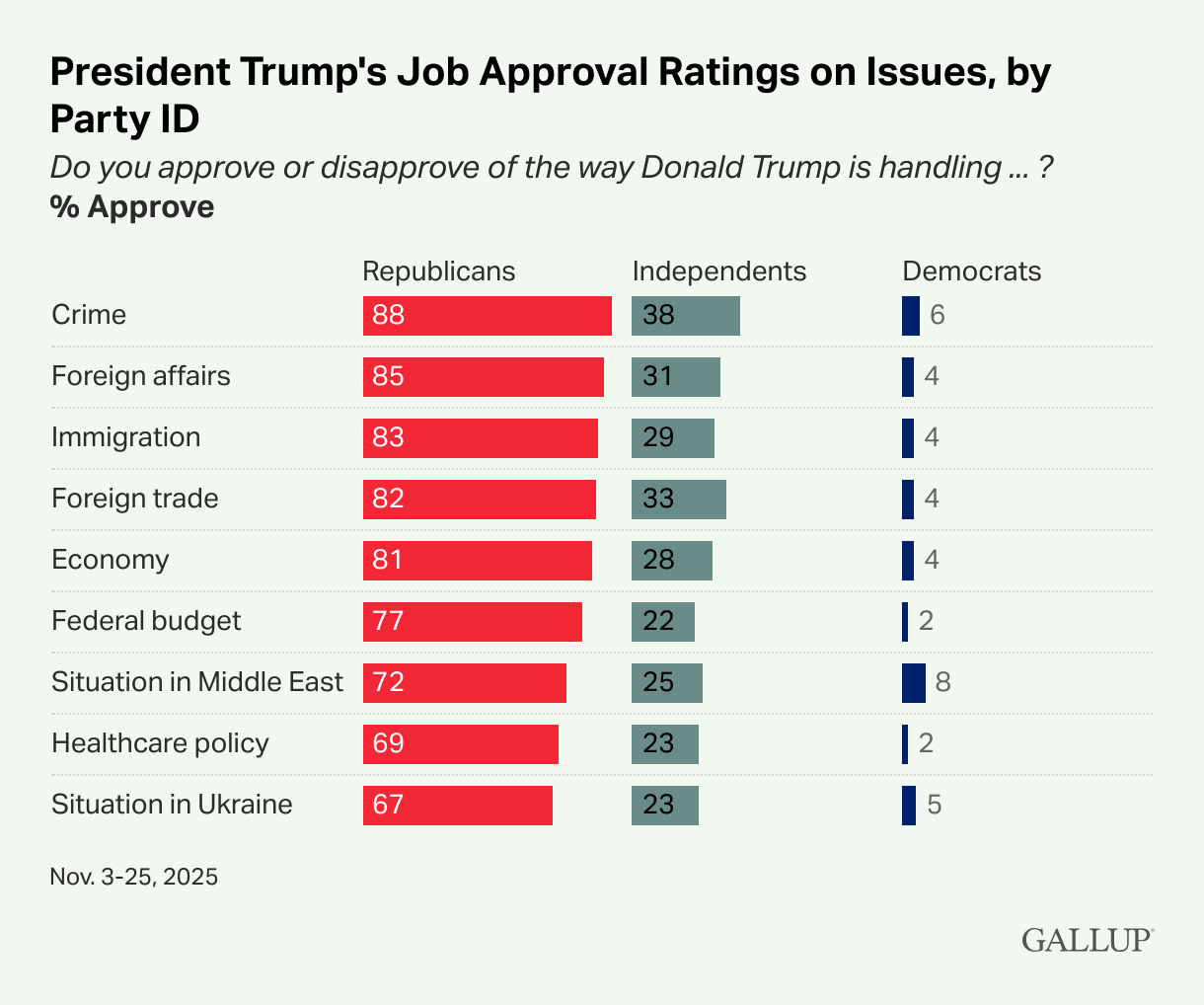
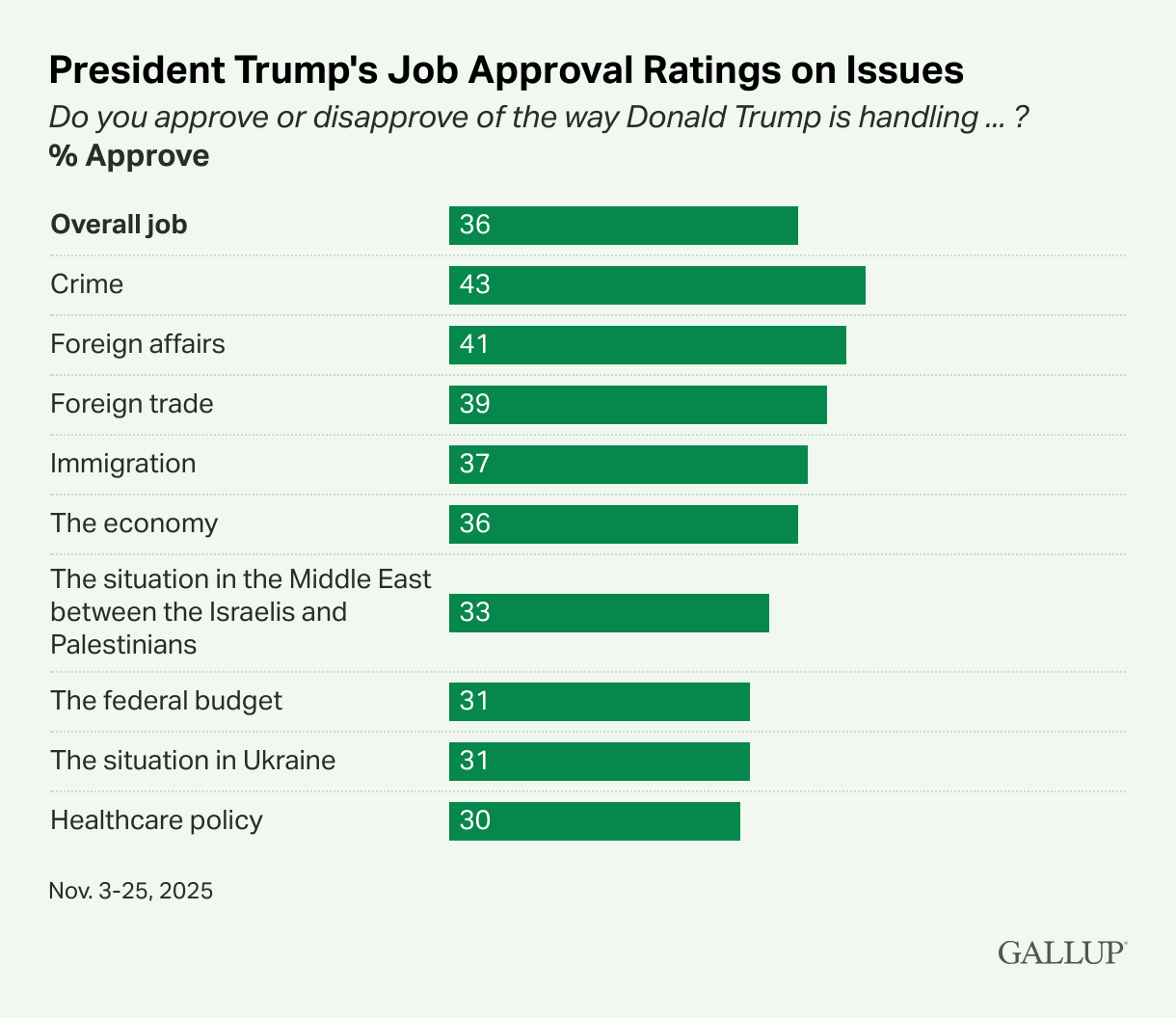
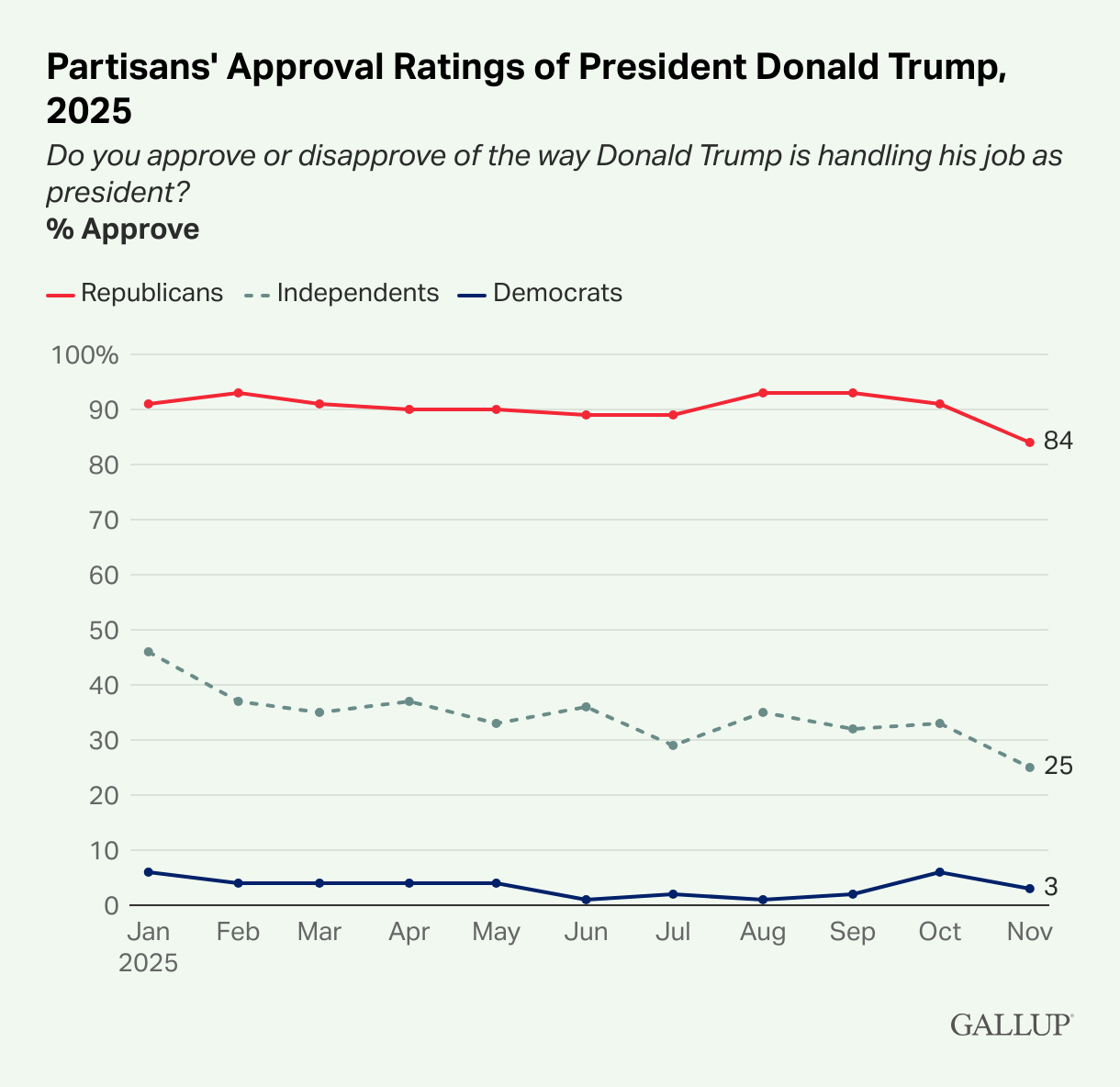
Quinnipac: Voters Give Democrats In Congress A Record Low Job Approval But Still Might Vote For Them In 2026, Quinnipiac University National Poll Finds; Majority Think Trump’S Use Of Presidential Power Goes Too Far
Published (49 tables/charts)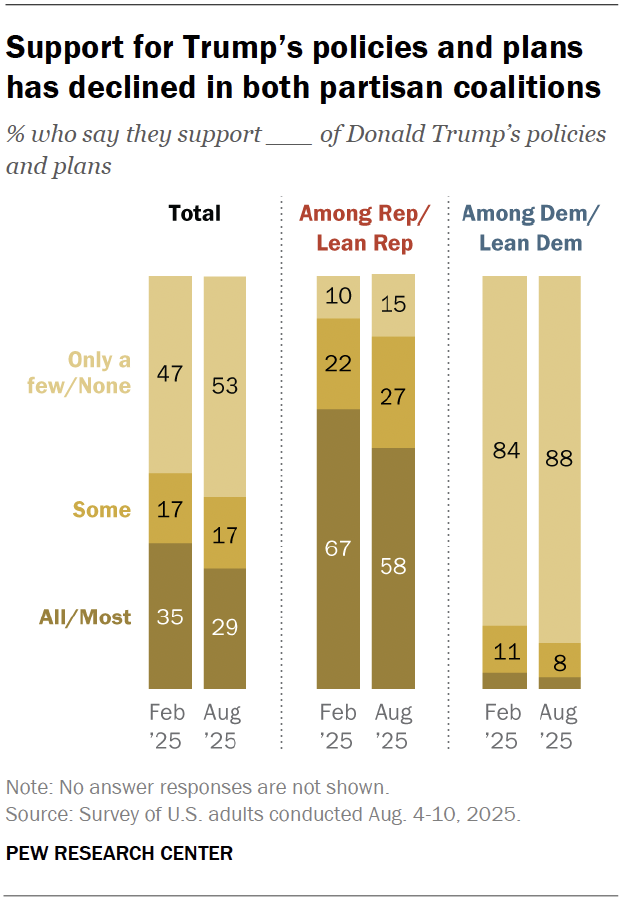

Pew: Confidence in Trump Dips, and Fewer Now Say They Support His Policies and Plans
Published (6 tables/charts)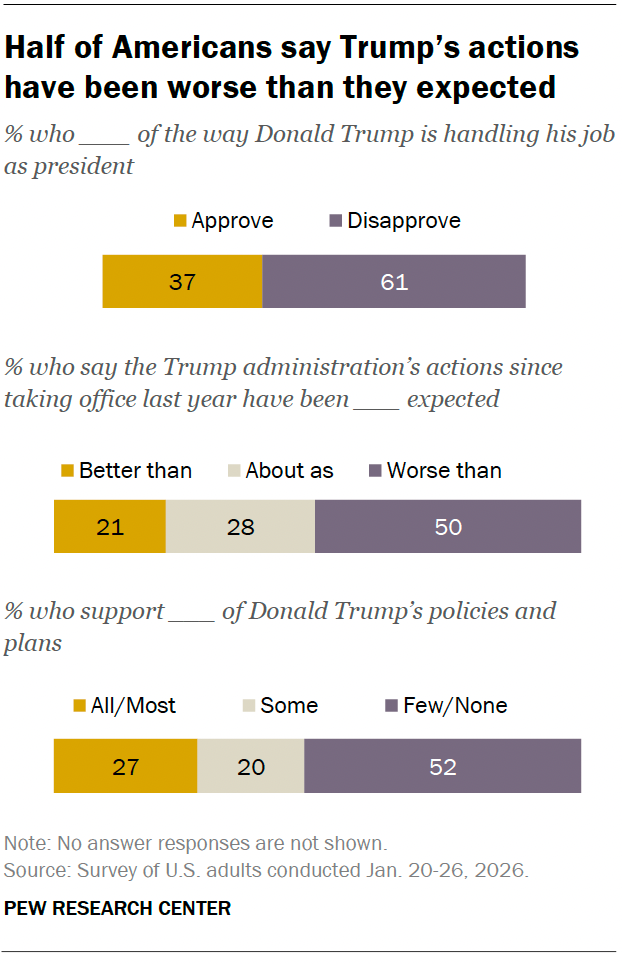
Pew: Confidence in Trump Dips, and Fewer Now Say They Support His Policies and Plans
Published (6 tables/charts)
Timeline
Nov 2024 – Trump wins the presidential election, flipping men 18‑29 by a narrow margin and securing a working‑class coalition that underpins his 2024 victory[14].
Early 2025 – The Federal Reserve cuts rates twice, lowering the policy rate to about 3.9% while inflation hovers near 3%, setting the macro backdrop for Trump’s “make America affordable again” pledge[1].
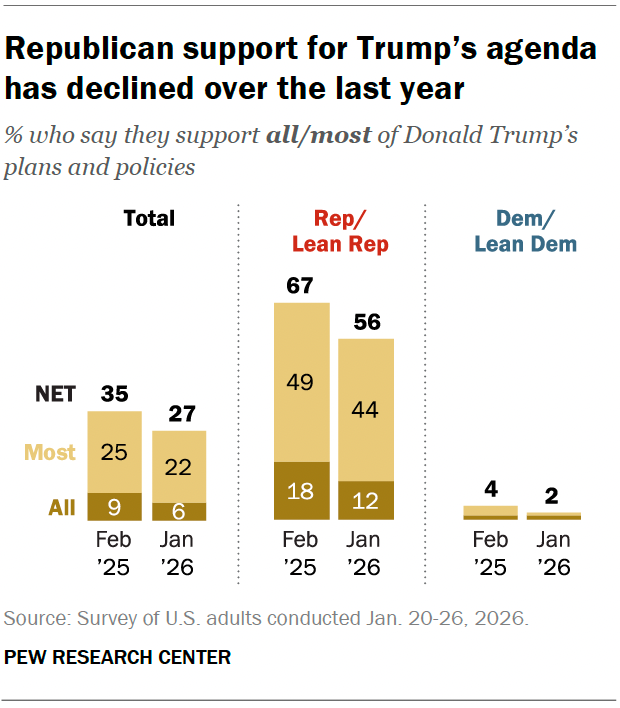
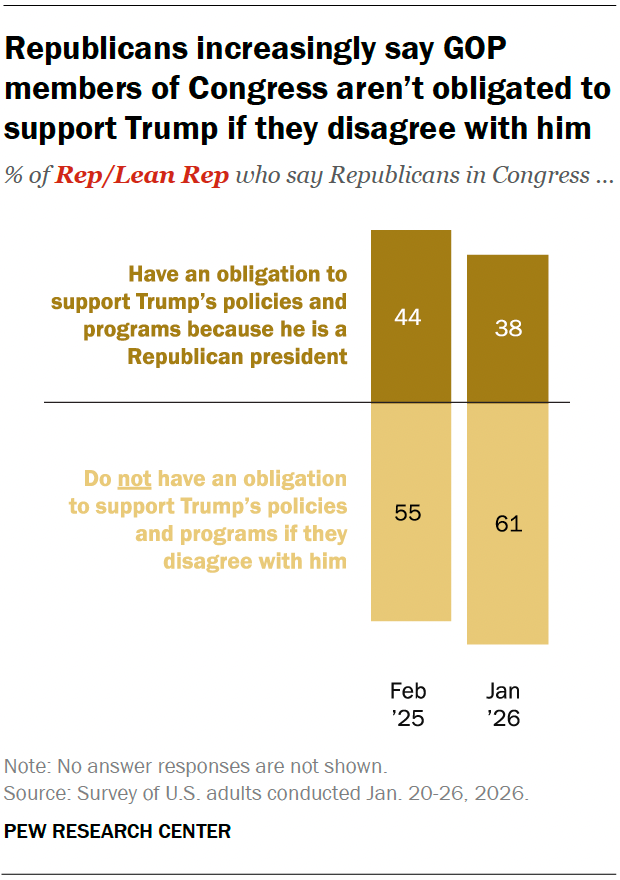
Feb 2025 – A Pew poll shows 67 % of Republicans and Republican‑leaning independents back “all or most” of Trump’s policies, marking the high point of party‑wide endorsement early in his second term[2].
Mar 2025 – AP‑NORC data record Trump’s economy approval at 40 % (down from 49 % in Feb 2025), immigration approval at 49 %, and crime approval at 53 %; 78 % of Republicans still approve his economic handling, highlighting a widening gap between the GOP base and the broader electorate[30].
Jul 2025 – Gallup reports Trump’s overall approval slipping to 37 % as GOP divisions erupt over a sweeping bill that extends 2017 tax cuts, expands immigration enforcement, and slashes HHS funding, linking legislative turmoil to his rating decline[19].
Aug‑Oct 2025 – Approval rebounds to 40 % in August and September, then climbs to 41 % in October, showing a brief recovery before the year‑end downturn[19].
Oct 1 – Nov 12 2025 – A 43‑day federal government shutdown fuels public dissatisfaction, contributing to lower approval scores in subsequent polls[19].
Nov 2025 – The Bureau of Labor Statistics releases the November CPI, showing inflation cooling to 2.7 % annualized, the lowest rate since March 2021, which the administration touts as evidence of economic progress[21].
Dec 9 2025 – Trump holds a rally in Pennsylvania, declaring that “consumer prices are falling tremendously” and that making America affordable again tops his agenda, even as overall inflation remains around 3 %[1].
Dec 10‑18 2025 – An RMG Research poll of 3,000 registered voters finds Trump at 50 % approval, his strongest showing from the pollster in over a month, while a week earlier the same poll recorded 47 % approval[20].
Dec 12‑15 2025 – A Fox News poll reports 44 % overall approval and 39 % approval of Trump’s economic management; 72 % of respondents rate economic conditions as only fair or poor, underscoring persistent cost‑of‑living worries[21].
Dec 15‑16 2025 – Quantus Insights surveys 1,000 voters, showing Trump’s approval at 44 % and disapproval at 53 %; support among non‑college‑educated voters drops to 46 % approval, reflecting growing unease among lower‑education groups[18].
Dec 18 2025 – Trump delivers a prime‑time national address, claiming his administration has “fixed the economy” and attacking President Biden; fact‑checkers label many of his price‑and‑wage statistics as exaggerated or inaccurate[4].
Dec 20 2025 – InsiderAdvantage polls 800 likely voters, producing a +8.4 net approval (49.5 % approve, 41.1 % disapprove) and prompting Trump to post on Truth Social that he has “the highest Poll Numbers I have ever received”[17].
Dec 22 2025 – InsiderAdvantage repeats the +8.4 net gain, noting strong gender, race, and age splits (e.g., 59 % of men approve) while highlighting a high share of undecided independents that the campaign must win over[17].
Dec 25 2025 – AtlasIntel’s December poll registers a –20 net rating for Trump (59.6 % disapprove, 39.3 % approve), while InsiderAdvantage again shows a +8.4 net, illustrating sharp polling volatility; SMU professor Jillson warns that cracks in the MAGA base could shape the 2026 midterms[16].
Dec 26 2025 – The YouGov/Economist working‑class survey finds only 31 % of voters earning ≤ $50 k approve of Trump, a historic low that follows a narrow working‑class win in the 2024 election and raises concerns about affordability as a midterm issue[15].
Dec 30 2025 – Harvard Youth and GenForward polls reveal that 62 % of Gen Z men disapprove of Trump, a reversal from his 2024 win among young men and a warning sign for GOP outreach to younger voters[14].
Dec 31 2025 – Year‑end trackers (NY Times, Silver Bulletin, RealClearPolitics) place Trump underwater on approval (≈ 42‑45 % approve, ≈ 53‑54 % disapprove), while DHS reports over 2 million illegal aliens have left the U.S., keeping immigration a central political flashpoint heading into 2026[13].
Jan 5‑7 2026 – CBS/YouGov data show 70 % of Americans think the economy is in bad shape and 66 % worry about affording health care, reinforcing the economy’s dominance as the top voter concern[9].
Jan 8‑11 2026 – AP‑NORC polls 1,203 adults, finding Trump’s overall approval near 40 % (unchanged from March 2025), economy approval at 37 % (up from a December low of 31 %), and immigration approval slipping to 38 % from 49 % in March[28].
Jan 9‑12 2026 – The Economist/YouGov low‑income wave records 36 % approval among households earning < $50 k, a modest rebound after a dip to 34 % earlier in the month, highlighting volatility in the demographic most sensitive to affordability issues[12].
Jan 13‑20 2026 – KFF’s Health Tracking Poll shows 66 % of Americans worry about health‑care costs, while the Angus Reid Institute finds non‑MAGA Republicans expressing strong negative views on affordability, underscoring health‑care as a potential midterm swing factor[9].
Jan 16‑20 2026 – An American Research Group poll places Trump at 35 % approval (‑28 net), with only 32 % approving his economic handling, marking the lowest ARG reading since his second term began and signaling deepening public unease[11].
Jan 20‑26 2026 – Pew Research surveys 8,512 adults, reporting Trump’s overall approval at 37 % (‑24 net) and disapproval at 61 %; 73 % of Republicans still approve, but half of respondents say his actions are “worse than expected,” and Harry Enten warns that a negative economic perception could cost the GOP the House in the 2026 midterms[10].
Jan 20‑26 2026 – Fox News polls 1,001 voters, showing 44 % overall approval and 39 % economy approval; 55 % of respondents have very little confidence in ICE, and 51 % back cuts to its funding, reflecting growing skepticism of immigration enforcement[9].
Jan 31‑Feb 1 2026 – InsiderAdvantage surveys 1,000 likely voters, finding Trump’s approval rebounding to 50 % (49.5 % approve, 49 % disapprove) after a dip triggered by the Jan 24 Minneapolis shooting of Alex Pretti; the White House emphasizes a “laser‑focused” agenda on inflation, growth, and border security[6].
Feb 2 2026 – Trump posts on Truth Social, proclaiming “the highest Poll Numbers I have ever received” and asserting that Americans love a “strong and powerful Country, with the best economy, EVER!”[6].
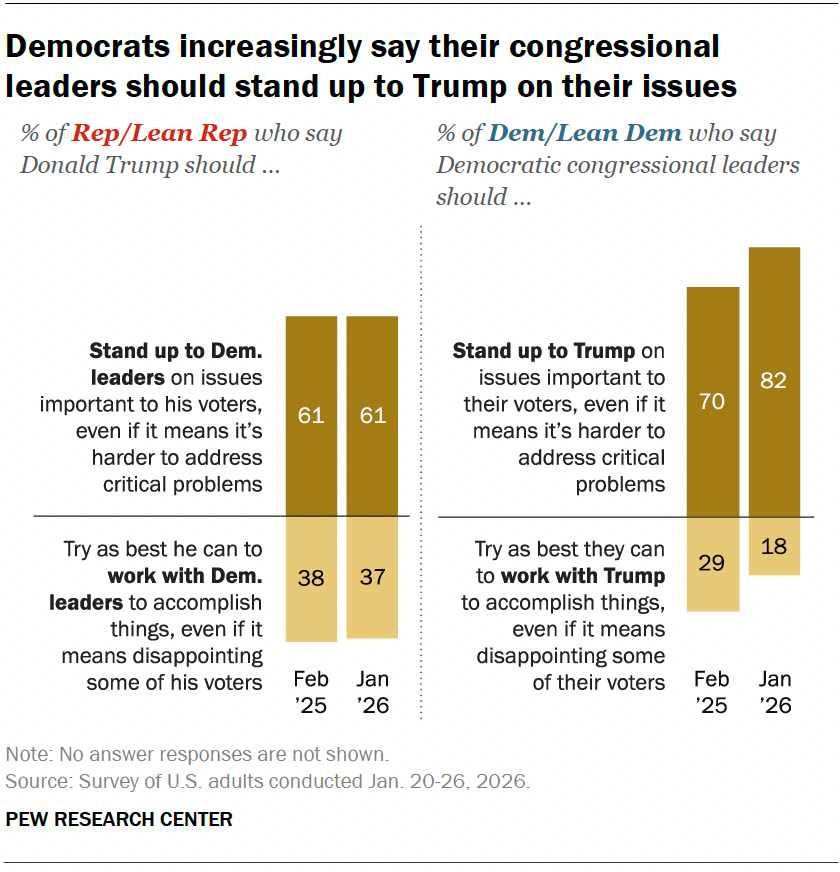
Feb 2 2026 – Polls following an SNL “mom confession” sketch reveal growing discontent among Trump voters: support for “all or most” of his policies falls from 67 % (Feb 2025) to 56 % (Jan 2026), and 7 in 10 voters say he isn’t spending enough time on the economy[2].
Feb 2 2026 – New surveys show voters doubt Trump’s affordability message; only 38 % approve his immigration approach (down from 49 % in March), and six‑in‑ten say ICE tactics have “gone too far,” indicating erosion of support for his enforcement stance[26].
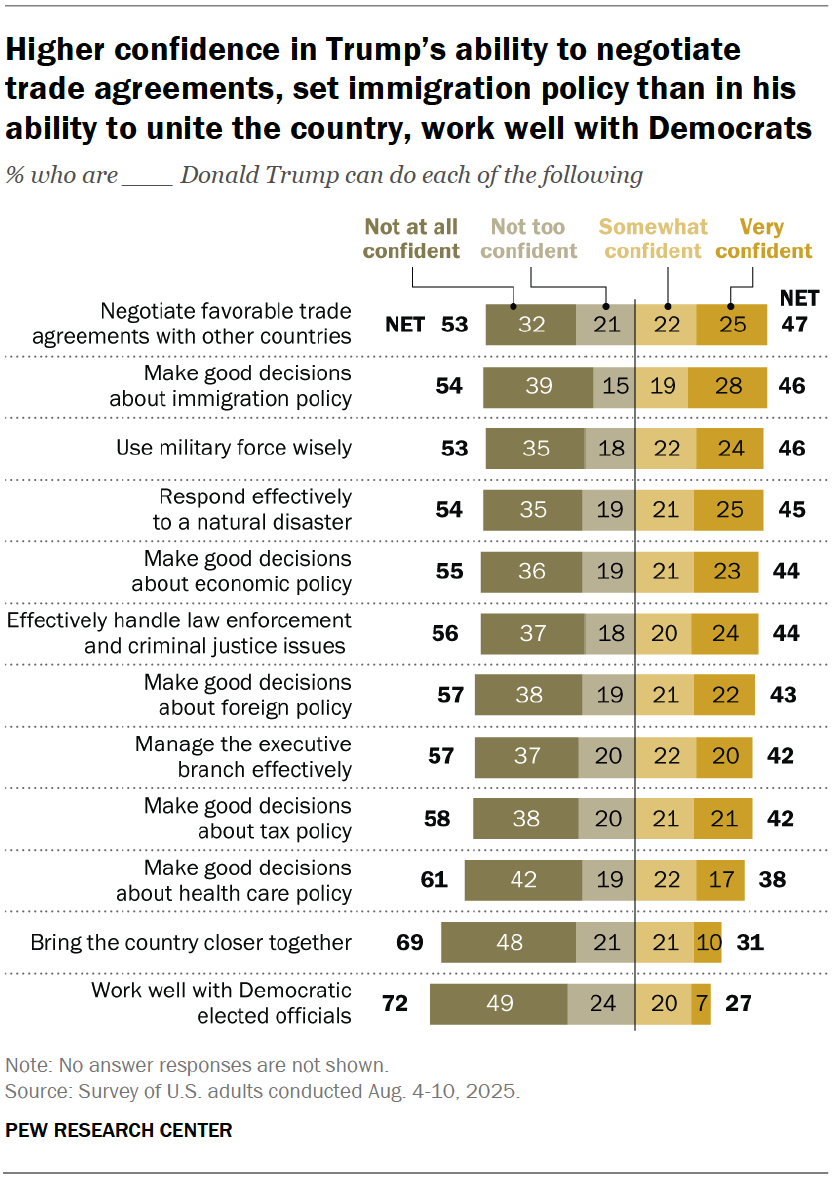
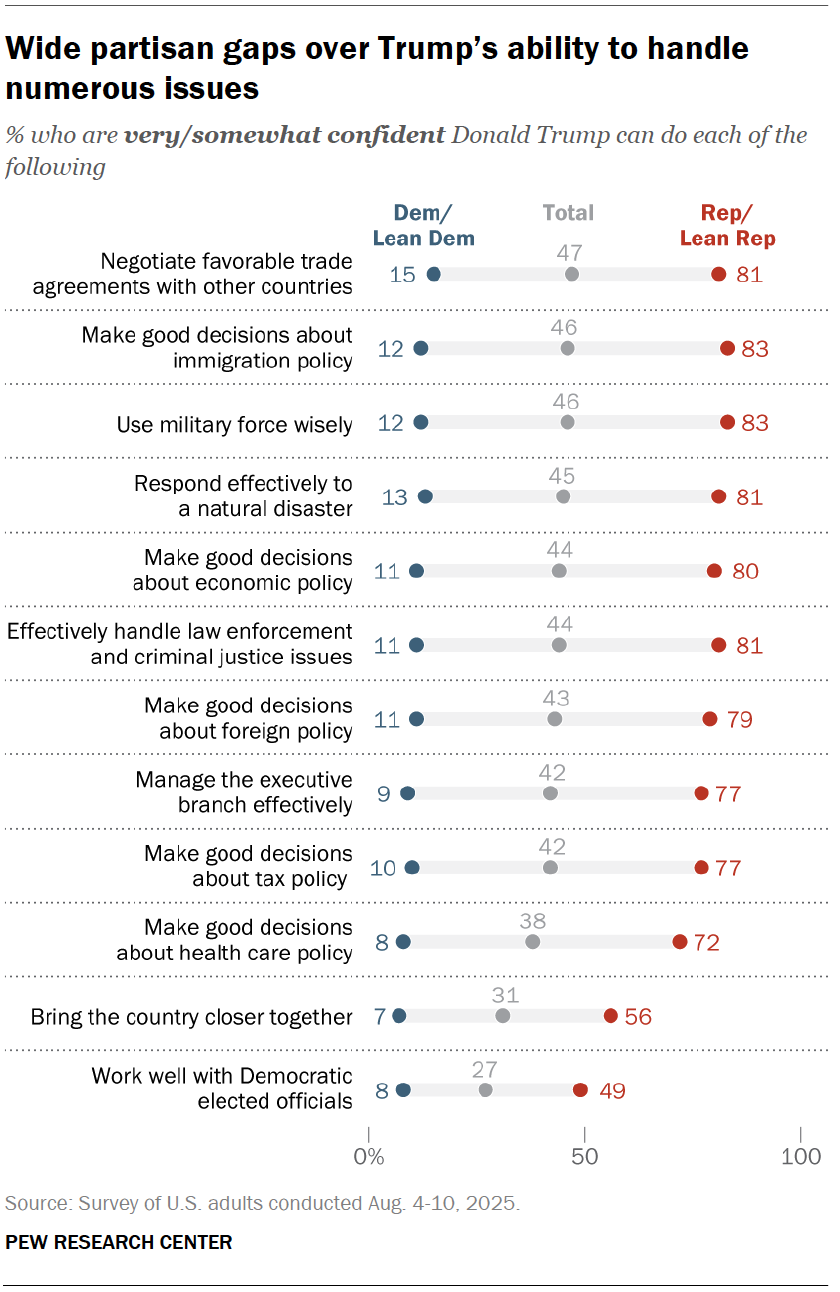
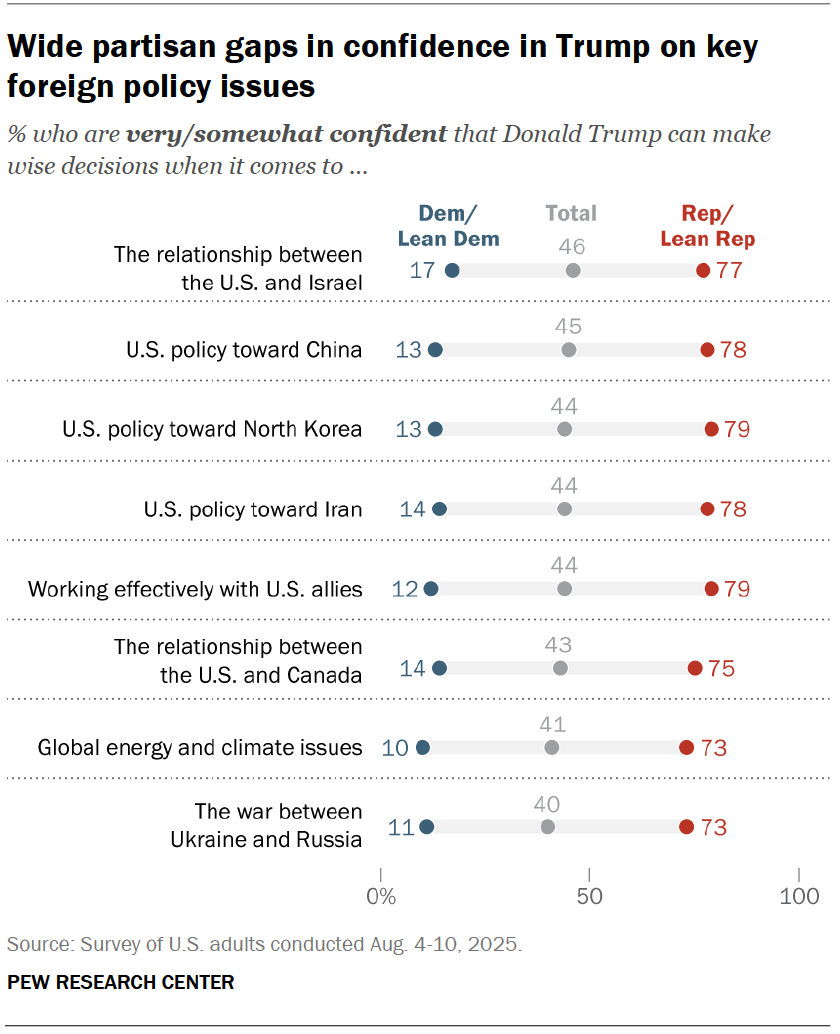
Feb 3 2026 – Harvard CAPS/Harris poll (2,000 voters) records overall approval at 45 % (down from 47 % in Dec 2025); issue‑specific ratings dip further—economy 43 %, immigration 46 %, foreign affairs 42 %—while 63 % of respondents still credit Trump for the current economy[8].
Feb 4 2026 – Civiqs analyzes 83,700 adults surveyed Jan 20‑Feb 3, showing core Republican states (e.g., Wyoming, West Virginia) still back Trump but at reduced levels, while battleground states (e.g., Arizona, Georgia) drift modestly away, narrowing GOP prospects in key 2026 contests[7].
Feb 5 2026 – RealClearPolitics averages Trump’s approval at 42.6 % (‑14.3 net on Nate Silver’s model), confirming that despite the InsiderAdvantage rebound, he remains underwater in most trackers[6].
Feb 16 2026 – A CNN/SSRS poll finds 58 % of Americans label Trump’s first year a failure; the economy tops issue importance by a two‑to‑one margin, and even among Republicans 9 in 10 approve of Trump, though many say he should act more aggressively on prices[3].
Feb 2026 (Upcoming) – The 2026 midterm elections loom, with analysts linking Trump’s economic perception to potential GOP losses in the House and noting that Democratic candidates may capitalize on affordability concerns highlighted throughout 2025‑2026 polls[10][9].
2028 (Speculated) – Former adviser Steve Bannon hints at a possible Trump run in 2028, while Trump himself mentions potential successors such as Vice President JD Vance and Secretary of State Marco Rubio, indicating long‑term strategic planning beyond his current term[24].
Dive deeper (10 sub-stories)
-
Trump’s Net Approval Plummets to Record Low of ‑26 in Early February Polls
(21 articles)
-
Trump’s Approval Slips Slightly Nationwide After Jan 24 Alex Pretti Shooting
(2 articles)
-
Trump’s Overall Approval Falls to 45% in January Poll Amid Midterm Build‑Up
(5 articles)
-
Trump’s Affordability Message Falters as Approval Drops and Immigration Criticism Grows
(8 articles)
-
Trump’s Urban Approval Rises to 40% in Late‑January Fox News Survey
(3 articles)
-
Trump’s Low‑Income Approval Slightly Rises to 36% in Early January Poll
(3 articles)
-
Newsweek: Trump ends 2025 with disapproval outweighing approval in major polls
-
Newsweek: Trump's approval rating falls through 2025, from 47% in January to 36% in November
-
AP: Trump’s 2024 Gains Face 2026 Uncertainty
-
CNN: Cracks in Trump’s base widen as polling shows disapproval across issues
All related articles (46 articles)
-
Newsweek: Trump’s Approval Rating Falls to Historic Lows Across Four National Polls
-
Newsweek: Trump’s Approval Bounces Back to 50 % in New InsiderAdvantage Poll
-
Newsweek: Trump Approval Shifts After Alex Pretti Shooting
-
Newsweek: Trump’s approval slips on every major issue, poll shows
-
CNN: Polls Reveal Growing Discontent Among Trump Voters After SNL Sketch
-
AP: Trump’s Affordability Pitch Fails to Convince Voters, Polls Show
-
Newsweek: Trump’s Approval Slips Amid Economic, Health‑Care and Foreign‑Policy Concerns
-
Newsweek: Trump’s Approval Drops to 37% in Latest Pew Survey
-
Newsweek: Trump’s Urban Approval Gains in Early 2026 Fox News Poll
-
Newsweek: Trump's second-term approval sinks in ARG poll
-
Newsweek: Trump approval slips in new polls as Gen Z support collapses
-
Newsweek: Trump's foreign policy approval hits record low in January 2026 polls
-
AP: AP-NORC poll: Republicans stay loyal to Trump on immigration as economy underperforms
-
CNN: CNN poll finds Americans say Trump is focused on the wrong priorities; economy dominates concerns
-
AP: AP-NORC poll shows Trump’s approval steady as economy and immigration shape views
-
Newsweek: Trump's low-income approval rebounds modestly in latest Economist/YouGov poll
-
Newsweek: Trump's approval rating edges up to low 40s amid policy events and voter unease
-
Newsweek: Late-2025 polls show Trump vulnerability as 2026 begins
-
Newsweek: Trump ends 2025 with disapproval outweighing approval in major polls
-
Newsweek: Trump's appeal to young men slips as polls show dip after 2024 victory
-
Newsweek: Trump's working-class approval sinks to historic low in YouGov/Economist poll
-
Newsweek: Trump's approval uptick largely reverses, Nate Silver reports
-
Newsweek: Trump’s approval sinks to double-digit deficit in GOP pollster reading
-
Newsweek: Trump posts highest net approval since August in December InsiderAdvantage poll
-
Newsweek: Trump approval declines to net -20 in AtlasIntel December poll
-
Newsweek: Trump approval dips among least-educated Americans in latest poll
-
Newsweek: Trump's state-by-state approval shows regional divides after 11 months
-
Newsweek: Trump's approval rating falls through 2025, from 47% in January to 36% in November
-
Newsweek: Trump approval reaches 50% in new RMG Research poll
-
Newsweek: Fox News poll shows declining support for Trump’s economy
-
CNN: Trump’s prime‑time address on economy draws criticism and low approval
-
CNN: Trump’s “Strongly Approve” Rating Hits New Low Across Recent Polls
-
Newsweek: Trump’s Approval Rating Shows Modest Recovery, According to Recent Polls
-
Newsweek: Trump’s Suburban Approval Drops to Record Low
-
AP: Trump’s 2024 Gains Face 2026 Uncertainty
-
Newsweek: Trump’s Urban Approval Rating Rises 6 Points in December 2025
-
AP: Trump’s economic approval hits lowest level in AP‑NORC polls
-
BBC: Trump vows to make US affordable again, as Americans feel the pinch
-
Newsweek: Donald Trump’s Approval Ratings in California Reach Second-Term Low
-
Newsweek: Trump Approval Rating Rises Among Women, New Poll Shows
-
Newsweek: Trump’s Approval Rating Among Young Voters Falls Into a “Black Hole”
-
Newsweek: Trump’s millennial approval improves slightly in latest Economist/YouGov poll (Dec 2025) [\[1\]](https://www.newsweek.com/donald-trump-approval-rating-millennials-improves-11160644)
-
CNN: Cracks in Trump’s base widen as polling shows disapproval across issues
-
Newsweek: Trump Voters Majority Oppose Third Term, Approval Rating Falls
-
Newsweek: Trump’s Net Approval Rating Falls to Second‑Term Low
-
Newsweek: Trump’s Approval Rating Plunges to a Second‑Term Low Amid Growing GOP Fragmentation
External resources (64 links)
- https://www.youtube.com/watch?v=-wQhY5CMMl4 (cited 1 times)
- https://www.pewresearch.org/methods/2025/11/20/video-why-have-polls-underestimated-donald-trump/ (cited 2 times)
- https://law.marquette.edu/poll/2025/11/18/detailed-results-of-the-marquette-law-school-supreme-court-poll-nov-5-12-2025-national-issues/ (cited 1 times)
- https://law.marquette.edu/poll/category/poll-release/ (cited 1 times)
- https://maristpoll.marist.edu/polls/2026-economic-outlook-december-2025/ (cited 1 times)
- https://maristpoll.marist.edu/wp-content/uploads/2025/11/NPR_PBS-News_Marist-Poll_USA-NOS-and-Tables_202511141156-1.pdf (cited 1 times)
- https://maristpoll.marist.edu/wp-content/uploads/2026/01/Marist-Poll_USA-NOS-and-Tables_202601141623.pdf (cited 1 times)
- https://news.gallup.com/interactives/507569/presidential-job-approval-center.aspx (cited 1 times)
- https://news.gallup.com/poll/652970/economy-immigration-abortion-democracy-driving-voters.aspx (cited 1 times)
- https://news.gallup.com/poll/699221/trump-approval-rating-drops-new-second-term-low.aspx' (cited 1 times)
- https://poll.qu.edu/poll-release?releaseid=3943 (cited 1 times)
- https://www.kff.org/public-opinion/kff-health-tracking-poll-health-care-costs-expiring-aca-tax-credits-and-the-2026-midterms/ (cited 1 times)
- https://www.pewresearch.org/politics/2025/08/14/views-of-trumps-policies-and-confidence-in-his-ability-to-handle-issues/ (cited 1 times)
- https://www.pewresearch.org/politics/2026/01/29/confidence-in-trump-dips-and-fewer-now-say-they-support-his-policies-and-plans/#do-republicans-in-congress-have-an-obligation-to-support-trump (cited 1 times)
- https://www.pewresearch.org/politics/2026/01/29/confidence-in-trump-dips-and-fewer-now-say-they-support-his-policies-and-plans/?utm_source=AdaptiveMailer&utm_medium=email&utm_campaign=26-01-29%20W185%20Main%20Report&org=982&lvl=100&ite=17283&lea=4831761&ctr=0&par=1&trk=a0DQm00000AFTqLMAX (cited 1 times)
- https://www.pewresearch.org/short-reads/2026/01/29/few-americans-support-trumps-proposed-takeover-of-greenland/ (cited 1 times)
- https://www.pewresearch.org/wp-content/uploads/sites/20/2026/01/PP_2026-01-29_views-of-trump_report.pdf (cited 1 times)
- https://apnorc.org/ (cited 4 times)
- https://static.foxnews.com/foxnews.com/content/uploads/2026/01/fox_january-23-26-2026_national_cross-tabs_january-28-release.pdf (cited 3 times)
- https://www.nytimes.com/interactive/2026/01/26/polls/times-siena-national-poll-crosstabs.html (cited 3 times)
- https://apnorc.org/projects/fewer-want-the-u-s-to-take-an-active-role-in-global-affairs/ (cited 2 times)
- https://apnorc.org/projects/the-public-is-concerned-about-trumps-policy-priorities/ (cited 2 times)
- https://www.foxnews.com/politics/fox-news-poll-donald-trump-starts-2026-44-approval (cited 2 times)
- https://apnorc.org/biden-approval-hits-new-low-at-one-year-mark-ap-norc-poll/ (cited 1 times)
- https://apnorc.org/projects/about-half-of-the-public-believe-the-number-of-legal-immigrants-to-the-u-s-should-remain-the-same/ (cited 1 times)
- https://apnorc.org/projects/bipartisan-dissatisfaction-with-the-direction-of-the-country-and-the-economy/ (cited 1 times)
- https://apnorc.org/projects/pessimism-about-the-direction-of-the-country-is-growing-among-republicans/?doing_wp_cron=1765394622.9358189105987548828125 (cited 1 times)
- https://apnorc.org/projects/trumps-approval-rating-remains-low-during-government-shutdown/ (cited 1 times)
- https://apnorc.org/wp-content/uploads/2025/12/AP-NORC-December-2025-Topline-Trump-121125.pdf (cited 1 times)
- https://static.foxnews.com/foxnews.com/content/uploads/2025/11/fox_november-14-17-2025_national_cross-tabs_november-19-release.pdf (cited 1 times)
- https://static.foxnews.com/foxnews.com/content/uploads/2025/11/fox_november-14-17-2025_national_topline_november-19-release.pdf (cited 1 times)
- https://static.foxnews.com/foxnews.com/content/uploads/2025/12/fox_december-12-15-2025_complete_national_cross-tabs_december-19-release.pdf (cited 1 times)
- https://static.foxnews.com/foxnews.com/content/uploads/2026/01/fox_january-23-26_national_topline_january-28-release.pdf (cited 1 times)
- https://www.ap.org/news-highlights/spotlights/2025/trump-the-america-first-candidate-has-a-new-preoccupation-imperialism/ (cited 1 times)
- https://www.foxnews.com/politics/fox-news-poll-59-voters-say-ice-too-aggressive-up-10-points-since-july.amp (cited 1 times)
- https://www.nytimes.com/2025/12/11/opinion/trump-approval-rating-affordability.html (cited 1 times)
- https://www.reuters.com/world/us/americans-skeptical-trump-epstein-republican-doubts-ease-reutersipsos-poll-finds-2025-12-12/ (cited 1 times)
- https://www.reuters.com/world/us/trump-approval-falls-lowest-his-term-over-prices-epstein-files-reutersipsos-poll-2025-11-18/ (cited 1 times)
- https://www.washingtonpost.com/politics/2025/12/12/minority-voters-trump-democrats-midterms/ (cited 1 times)
- https://truthsocial.com/@realDonaldTrump/posts/115939860152214301 (cited 1 times)
- https://x.com/realDonaldTrump (cited 1 times)
- https://www.rasmussenreports.com/public_content/politics/trump_administration_second_term/trump_approval_index_history_second_term (cited 2 times)
- http://d3nkl3psvxxpe9.cloudfront.net/documents/econTabReport_qsNv5iE.pdf (cited 1 times)
- http://today.yougov.com/politics/articles/53954-confidence-ice-falling-half-americans-support-cutting-ice-funding-january-23-26-2026-economist-yougov-poll (cited 1 times)
- https://civiqs.com/results/abolish_ice?uncertainty=true&zoomIn=true&annotations=true (cited 1 times)
- https://civiqs.com/results/approve_president_trump_2025?uncertainty=true&zoomIn=true&annotations=true&map=true (cited 1 times)
- https://d3nkl3psvxxpe9.cloudfront.net/documents/econTabReport_8FWGyNz.pdf (cited 1 times)
- https://d3nkl3psvxxpe9.cloudfront.net/documents/econTabReport_K8wS7V4.pdf (cited 1 times)
- https://d3nkl3psvxxpe9.cloudfront.net/documents/econTabReport_aY8mpiN.pdf (cited 1 times)
- https://d3nkl3psvxxpe9.cloudfront.net/documents/econTabReport_h1aYmmb.pdf (cited 1 times)
- https://d3nkl3psvxxpe9.cloudfront.net/documents/econTabReport_h1aYmmb.pdf#page=24 (cited 1 times)
- https://d3nkl3psvxxpe9.cloudfront.net/documents/econTabReport_nBgFw7w.pdf (cited 1 times)
- https://d3nkl3psvxxpe9.cloudfront.net/documents/econTabReport_qLhWxpK.pdf (cited 1 times)
- https://d3nkl3psvxxpe9.cloudfront.net/documents/econTabReport_qsNv5iE.pdf (cited 1 times)
- https://d3nkl3psvxxpe9.cloudfront.net/documents/econTabReport_szm0BQt.pdf (cited 1 times)
- https://harvardharrispoll.com/wp-content/uploads/2025/12/HHP_Dec2025_KeyFindings.pdf (cited 1 times)
- https://harvardharrispoll.com/wp-content/uploads/2026/02/HHP_Jan2026_KeyResults.pdf (cited 1 times)
- https://insideradvantage.com/insideradvantage-national-survey-trump-bounces-back-to-50-approval-nearly-60-say-melania-trump-media-coverage-is-biased/ (cited 1 times)
- https://kfoxtv.com/news/nation-world/sen-paul-says-trumps-base-is-irritated-by-continued-involvement-in-ukraine-venezuela-argentina-russia-lindsey-graham (cited 1 times)
- https://polls.decisiondeskhq.com/averages/presidential-approval/donald-trump-150479/national/lv-rv-adults (cited 1 times)
- https://www.conference-board.org/topics/consumer-confidence/ (cited 1 times)
- https://www.natesilver.net/p/trump-approval-ratings-nate-silver-bulletin (cited 1 times)
- https://www.scribd.com/document/955164028/Yahoo-YouGov-Epstein-Poll-November-2025 (cited 1 times)