East Coast Faces Up to Two Feet Snow, Travel Ban, and 3,500 Flight Cancellations
Updated (131 articles)
-
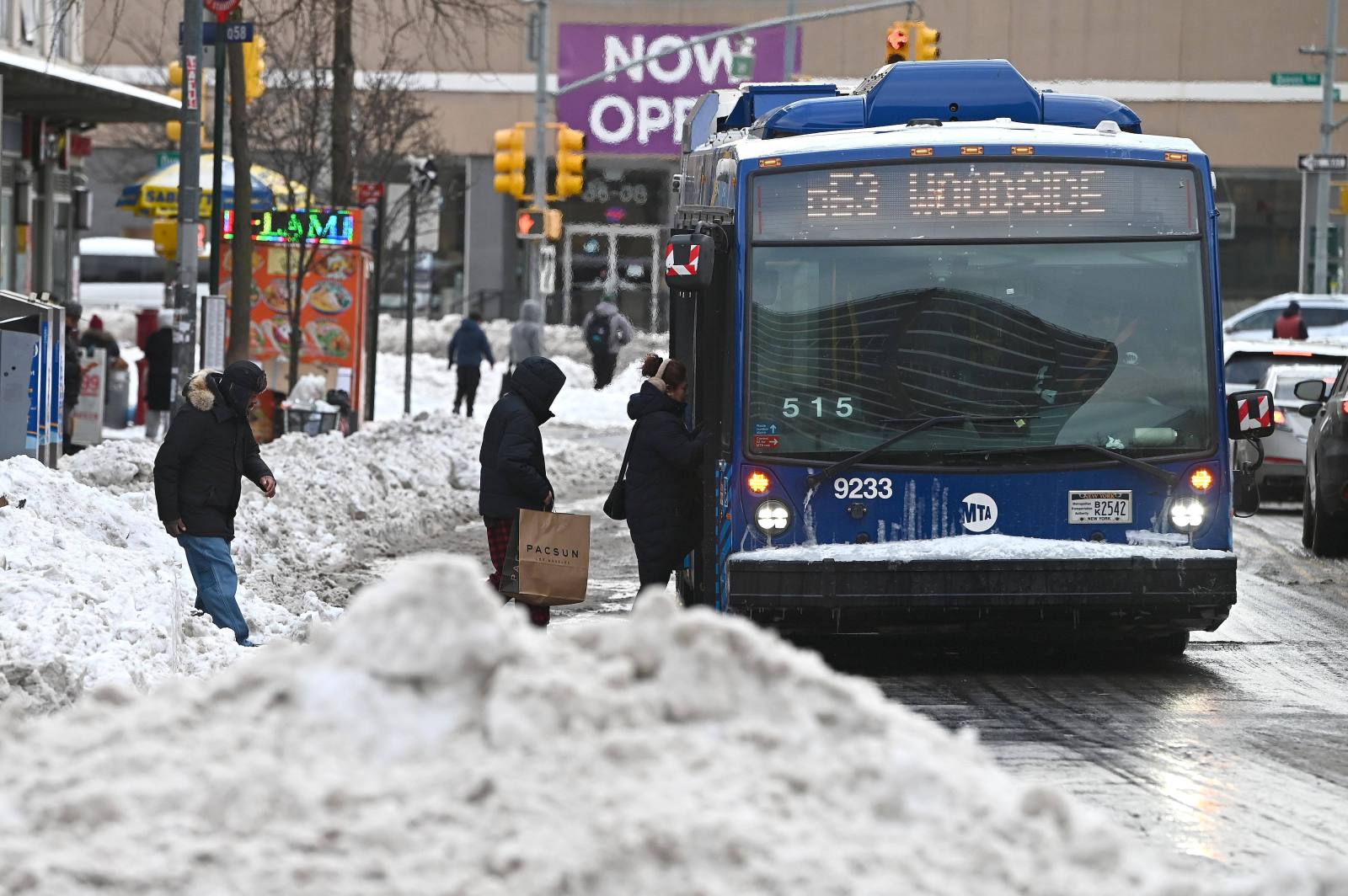 Image: NewsweekCommuters walk over berms of snow created by snow plows to board their bus in the New York City Borough of Queens, NY, January 26, 2026. New York City and it’s five boroughs saw more than 10 inches of snow fall at a rate of 1 to 2 inches per hour with freezing gusts of wind after a massive winter storm blanketed the US East Coast. (Photo by Anthony Behar/Sipa USA)(Sipa via AP Images) Source Full size
 -
Image: NewsweekCommuters walk over berms of snow created by snow plows to board their bus in the New York City Borough of Queens, NY, January 26, 2026. New York City and it’s five boroughs saw more than 10 inches of snow fall at a rate of 1 to 2 inches per hour with freezing gusts of wind after a massive winter storm blanketed the US East Coast. (Photo by Anthony Behar/Sipa USA)(Sipa via AP Images) Source Full size
Bomb Cyclone Nor’easter Intensifies Into Major Blizzard A rapidly deepening nor’easter turned into a bomb cyclone Sunday, prompting blizzard warnings for New York City, Long Island, Boston and coastal communities from Delaware to Massachusetts. The National Weather Service now forecasts 1‑2 feet of wet, heavy snow with wind gusts up to 55 mph, creating white‑out conditions and severe travel hazards[2][3]. Meteorologist Cody Snell labeled the system a “major winter storm” and warned that such intensity is rare for the Northeast[1].
Governors and Mayors Declare States of Emergency New Jersey Gov. Mikie Sherrill and New York Gov. Kathy Hochul each issued emergency declarations, while NYC Mayor Zohran Mamdani imposed a travel ban and cancelled schools, and Philadelphia Mayor Cherelle Parker declared a city‑wide snow emergency[2][4]. Emergency orders include reduced speed limits to 35 mph in New Jersey and mobilization of the New York National Guard to protect vulnerable neighborhoods[4]. Local officials across Connecticut, Rhode Island and Massachusetts echoed the directives, urging residents to stay home and stock supplies[4].
Travel Restrictions and Flight Cancellations Disrupt Millions Mamdani’s travel ban bars non‑essential traffic from 9 p.m. Sunday to noon Monday, and New Jersey’s speed‑limit reduction remains in effect until further notice[1]. FlightAware reported more than 3,500 U.S. flight cancellations by Sunday afternoon, with CNN noting over 6,000 flights canceled across Sunday and Monday, especially at New York and Boston airports[1][2]. The combined road and air shutdown affects an estimated 14 million residents across the region[4].
Snow Removal Crews Mobilize for Week‑Long Cleanup Snow‑removal firm Berrington Snow Management positioned 40 front‑end loaders and snow‑clearing vehicles for 24‑ to 36‑hour shifts, anticipating at least a week of continuous work on Long Island and other hard‑hit areas[1][3]. NYC deployed extra snow‑clearing equipment from outside the city and used geocoding tools to prioritize bus stops and crosswalks, while opening more than 40 warming centers for the homeless[2][3]. The New York National Guard staged 100 members across Long Island, NYC and the Lower Hudson Valley to assist vulnerable populations[4].
Power Outages and Coastal Flooding Expected Forecasts call for sustained winds of 25‑35 mph, with gusts up to 70 mph in some locations, capable of snapping tree limbs and triggering scattered power outages[3][4]. Heavy, wet snow combined with wind could overload power lines and cause localized flooding during the Sunday night high tide, especially along the shoreline of New Jersey and Long Island[2][5]. Officials warned residents to prepare three‑day supplies and charge electronics in anticipation of prolonged outages[4].
Sources
-
1.
AP: East Coast Braces for Up to Two Feet of Snow as Blizzard Alerts Sweep Region – Details the storm’s onset, mayoral travel ban, emergency declarations, flight cancellations, and snow‑removal preparations.
-
2.
CNN: Bomb Cyclone Nor’easter Triggers Blizzard Warnings Across New York, Northeast – Emphasizes bomb‑cyclone development, emergency orders, warming centers, and extensive flight disruptions.
-
3.
AP: East Coast Braces for Blizzard‑Scale Snow and Winds – Highlights upgraded forecasts, blizzard warnings, NYC’s resource deployment, and Berrington’s week‑long cleanup plan.
-
4.
Newsweek: Northeast Braces for Up to 18 Inches of Snow as Governors Declare Emergencies – Focuses on state‑level emergencies, National Guard activation, three‑day supply advice, and power‑outage risks.
-
5.
CNN: East Coast Winter Storm Forecast Shifts Toward Heavier Snow and Strong Winds – Discusses evolving model scenarios, bomb‑cyclone potential, and the uncertainty surrounding exact snowfall totals.
Related Tickers
Timeline
Jan 2019 – A polar‑vortex outbreak drives record‑low temperatures across the United States, with Chicago reaching –23 °F, wind chills below –50 °F, railroads damaged, schools closed, and hypothermia deaths, illustrating the severe impacts when the vortex weakens [24][30].
Dec 2, 2025 – A powerful nor’easter advances across the Midwest and Northeast, dropping snow in New York and Pennsylvania, prompting Ohio counties to declare snow emergencies, rescuing a tractor‑trailer driver from a bridge in West Virginia, and leading Gov. Hochul and Gov. Mills to urge residents to avoid driving as hazardous conditions spread [25].
Dec 4, 2025 – The National Weather Service issues a freeze warning for eastern Arizona, forecasting temperatures in the 20s that threaten crops, vegetation, and outdoor plumbing, while a broader winter‑storm warning brings 12‑24 inches of snow and 55 mph winds to the Intermountain West [23].
Dec 9, 2025 – The Climate Prediction Center projects an Arctic blast that will push frigid air into the Eastern U.S., with a stretched polar vortex delivering wind chills well below zero and mid‑December expected to be the coldest period of the season, according to experts Judah Cohen and others [21][29].
Dec 9, 2025 – Nine‑state winter‑storm warnings forecast up to 14 inches of snow, 55 mph wind gusts, and avalanche danger across the Plains, Rockies, and Upper Midwest, while North Carolina faces icy travel advisories and Wyoming sees 10‑20 inches with extreme winds [22].
Dec 10, 2025 – Winter‑storm warnings across the Northeast, Great Lakes, and Rockies predict up to 20 inches of snow, 50‑60 mph winds, and heightened avalanche risk, prompting travel advisories and urging residents to monitor local forecasts [20].
Dec 12, 2025 – Forecasters anticipate a two‑wave Arctic air surge that first pushes sub‑zero temperatures through the Great Lakes on Tuesday night, then returns early weekend with wind chills below zero and gusts near 40 mph, while the Northeast expects foot‑plus snowfall and possible pockets extending into the Tennessee River Valley [26].
Dec 17, 2025 – The CPC 6‑10‑day outlook shows above‑average temperatures across most of the U.S. for Christmas, but highlights snow chances in the intermountain West, northern New England, and the Great Lakes, and identifies Monday, Dec 22 and Tuesday, Dec 23 as the best travel days [28].
Dec 22, 2025 – The National Weather Service issues a string of winter‑weather advisories and storm watches ahead of a fast‑moving system that could bring light snow, a wintry mix, and freezing rain to the Northeast, prompting officials to warn of low visibility and hazardous commutes [18].
Dec 26, 2025 – Gov. Kathy Hochul declares a state of emergency in more than half of New York’s counties as Central Park records 4.3 inches of snow, flights cancel, Code Blue activates to shelter the homeless, and neighboring states also declare emergencies amid 6‑10‑inch accumulations from Syracuse to Long Island [4].
Dec 27, 2025 – A winter storm disrupts holiday travel across the Northeast and Great Lakes, causing at least 1,500 flight cancellations, 4‑inch snow in New York City, and state‑of‑emergency declarations in New York and New Jersey, while California suffers concurrent rain‑induced floods and mudslides [16][27].
Jan 12, 2026 – The Arctic air surge continues, sending a second cold front into the Midwest with wind gusts near 40 mph, wind chills below zero, and snowfall that could exceed a foot in the higher elevations of the Northeast, while forecasters urge residents to secure outdoor items and monitor updates [26].
Jan 16, 2026 – The National Weather Service Twin Cities office warns that wind chills could reach minus 24 °F, causing frostbite in about 15 minutes, as protests and ICE activity in Minneapolis face dangerous exposure amid a severe cold snap [15].
Jan 21, 2026 – The Weather Prediction Center expands a major winter storm from the Southern Rockies to the East Coast, warning of heavy snow, sleet, freezing rain, and life‑threatening conditions across Texas to the Mid‑Atlantic, while meteorologist Stephanie Abrams calls the system “plan‑changing” [13]; the same day, Extreme Cold Warnings cover Minnesota and North Dakota with wind chills down to –55 °F, prompting safety advisories about frostbite risk [14].
Jan 22, 2026 – The National Weather Service warns that an Arctic blast will sweep 30 states, bringing more than a foot of snow to Colorado, West Virginia, and upstate New York, and wind chills below –50 °F across the Northern Plains, prompting governors in Arkansas, Georgia, Texas, North Carolina, and South Carolina to declare emergencies and mobilize National Guard resources [3]; climate researchers note the storm occurs as the West experiences its warmest winter on record, highlighting the complex link between vortex stretching and extreme cold [12].
Jan 24, 2026 – The NWS declares the approaching system “extremely dangerous,” projecting over a foot of snow from Colorado to West Virginia, wind chills below –50 °F in the Northern Plains, and sub‑zero temperatures that threaten hypothermia and frostbite, while Governors Hochul and Abbott ready thousands of plows, 114,000 tonnes of salt, and assure no grid failure is expected [1].
Jan 25, 2026 – A historic U.S. winter storm spreads heavy snow, damaging ice, and extreme cold across the Plains, Ohio Valley, Mid‑Atlantic, and Northeast, delivering 6‑12 inches of snow, record‑low temperatures, and widespread power outages affecting hundreds of thousands, as CNN tracks the evolving impact [10]; AP photo coverage shows residents using torches to thaw frozen doors and retailers facing stockpiling as the storm progresses [11].
Jan 26, 2026 – The winter storm sweeps from Texas to Maine, burying major cities under 20‑plus inches of snow, causing over 500,000 power outages, more than 6,000 flight cancellations, and at least 20 deaths across multiple states, while the National Weather Service warns that another major winter storm could strike the eastern U.S. on Friday, potentially bringing additional heavy precipitation and cold [2].
Jan 28, 2026 – A winter‑storm warning for Michigan, Alaska, and New York predicts up to 12 inches of snow, 60 mph winds, and blizzard conditions, with Onondaga County, NY expecting 3‑6 inches and Michigan’s Upper Peninsula facing up to 9 inches, prompting travel cautions for commuters [9].
Feb 4, 2026 – The National Weather Service issues winter‑storm watches for West Virginia, western Maryland, and Pennsylvania, forecasting 4‑7 inches of snow and 50 mph gusts in Charleston, up to 6 inches and whiteout conditions in Baltimore, and up to 6 inches with sub‑quarter‑mile visibility in Pittsburgh, while noting the system follows a recent bomb cyclone that dumped over a foot of snow in North Carolina [7]; a separate winter‑weather warning expects up to seven inches of snow across New York, North Carolina, Virginia, and Alaska, with freezing rain threatening power lines in NC [8].
Feb 21, 2026 – A bomb‑cyclone nor’easter rapidly intensifies off the Eastern Seaboard, becoming a bomb cyclone that brings blizzard conditions, over a foot of snow (potentially up to two feet) from Philadelphia to Boston, and 40‑55 mph winds, prompting emergency declarations in New Jersey, New York, and Philadelphia, while Mayor Zohran Mamdani orders additional snow‑clearing crews and opens more than 40 warming centers [5].
Feb 22, 2026 – The nor’easter continues as a major blizzard, with Weather Prediction Center meteorologist Cody Snell calling it a “major winter storm and a major impact,” forecasting 1‑2 feet of snow, a travel ban, school cancellations, and a 35 mph speed limit in New Jersey; FlightAware reports over 3,500 flight cancellations and snow‑removal firms prepare for week‑long cleanups on Long Island [6].
Feb 23‑24, 2026 (forecast) – Forecasters anticipate lingering lake‑effect snow showers around the Great Lakes through the week and warn that the bomb cyclone’s coastal flooding and power‑outage risks could persist into early March, urging residents to remain vigilant and maintain emergency supplies [5][6].
Dive deeper (27 sub-stories)
-
East Coast Braces for Bomb‑Cyclone Nor’easter Bringing Up to Two Feet of Snow
(3 articles)
-
East Coast Braces for Blizzard‑Scale Snow, High Winds as Storm Hits Sunday
(5 articles)
-
Northeast Governors Declare Emergencies as Blizzard Threatens 12‑18 Inches of Snow
(2 articles)
-
Arctic Surge Brings -30°F Wind Chills and 55‑Mph Gusts Across Mid‑Atlantic
(15 articles)
-
High‑Pressure Ridge Brings Nationwide Warmth While Northeast Stays Bitterly Cold
(3 articles)
-
Winter Weather Warning Expands to Four States, Up to Seven Inches Expected Feb 4‑5
(11 articles)
-
Extreme Cold Warnings Sweep Five States as Record Arctic Air Hits Florida
(4 articles)
-
Winter Storm Dumps Up to 12 Inches of Snow Across 14 States, Near‑Whiteout Conditions Expected
(2 articles)
-
Winter Storm Warnings Target Over One Million Residents as Snow and Ice Threaten Power Grid
(2 articles)
-
Polar Vortex Stretch and Warm Gulf Drive Late‑January 2026 U.S. Winter Storm
(5 articles)
-
Death Toll Hits Thirty as Winter Storm Fern Intensifies and New Clip‑Series Looms
(2 articles)
-
Forecasters Alert New Major Winter Storm Threatening Eastern U.S. Friday
(10 articles)
-
Winter Storm of Jan 25‑26, 2026 Paralyzes U.S., Sparks Snow‑Covered Urban Scenes
(2 articles)
-
Massive Winter Storm Blankets 40% of U.S., Triggers Power Outages and Federal Declarations
(25 articles)
-
Winter Storm Sweeps U.S., Alerts Cover 2,000 Miles, 390 Million Affected
(3 articles)
-
Trump Claims FEMA Ready as Winter Storm Fern Threatens Half U.S. Population
(3 articles)
-
Winter Storm Warning Brings Up to 3 Feet Snow and 40‑Mph Winds Across Eight States
(7 articles)
-
Extreme Cold Warnings Bring -55°F Wind Chills to Minnesota, North Dakota
(2 articles)
-
Extreme Cold Watch Targets Over 4 Million in Central California on Jan 9
(2 articles)
-
Winter Storm Warnings Bring Up to 24 Inches Snow Across Pacific Northwest
(2 articles)
-
Cold Arctic Air Hits Northeast While California Braces for New Year’s Eve Rain
(7 articles)
-
Winter Storm Warnings Sweep Ten States, Alaska Braces for Up to 45 Inches
(2 articles)
-
Post‑Christmas Storm Brings Freezing Rain, Snow and Travel Hazards Across Great Lakes Region
(6 articles)
-
Newsweek: Winter storm warnings spread across U.S. with up to 3 feet forecast
-
Newsweek: Arizona Freeze Warning: Temperatures May Drop Into 20s on Friday Morning
-
Winter Storm Warning Extends Through Thursday, Up to 20 Inches Predicted in Colorado Mountains
(2 articles)
-
Dec 2 2025 Nor’easter Brings First Seasonal Snow, Fatalities and State Emergencies
(2 articles)
All related articles (131 articles)
-
AP: East Coast Braces for Up to Two Feet of Snow as Blizzard Alerts Sweep Region
-
CNN: Bomb Cyclone Nor’easter Triggers Blizzard Warnings Across New York, Northeast
-
AP: East Coast Braces for Blizzard‑Scale Snow and Winds
-
Newsweek: Northeast Braces for Up to 18 Inches of Snow as Governors Declare Emergencies
-
CNN: East Coast Winter Storm Forecast Shifts Toward Heavier Snow and Strong Winds
-
Newsweek: Mid‑Atlantic and Northeast Brace for ‑30°F Wind Chills as Arctic Surge Hits
-
Newsweek: Winter Storm Watches Issue Alerts for West Virginia, Maryland and Pennsylvania
-
King5 (Seattle, WA): Warmer Temperatures Expected Across Much of the U.S. as High‑Pressure Ridge Builds
-
Newsweek: Winter Weather Warning Brings Up to Seven Inches of Snow Across Four States
-
Newsweek: Winter Weather Warning Brings Up to 7 Inches of Snow Across Eight States
-
Newsweek: Extreme Cold Warnings Sweep Five States, Prompting Health and Travel Alerts
-
CNN: Arctic Air Surge Threatens Snow on Florida Gulf Coast Amid Record Cold
-
Newsweek: Winter Storm Brings Up to 12 Inches of Snow and Near‑Whiteout Conditions Across 14 States
-
Newsweek: Winter Storm Warning Issued for Over 1 Million People
-
WBNS (Columbus, OH): How a Polar Vortex Stretch and Warm Gulf Fueled the Late‑January 2026 U.S. Winter Storm
-
King5 (Seattle, WA): Polar vortex stretch and warm Gulf boost Jan 2026 U.S. winter storm
-
Newsweek: Winter Storm Warning Brings Snow, High Winds to Michigan, Alaska and New York
-
Newsweek: Death Toll Climbs as Winter Storm Fern Sweeps U.S.
-
BBC: Winter Storm Sweeps U.S. and Canada, Leaving Dozens Dead and Massive Disruptions
-
Newsweek: Extreme Cold and Freeze Warnings Issued for 15 U.S. States
-
Newsweek: New Clip‑Series of Snowstorms Set to Blanket 14 States
-
AP: Winter Storm Paralyzes U.S., Sparks Snow‑Covered Scenes on Jan 25, 2026
-
WBNS (Columbus, OH): Massive Winter Storm Blankets 40% of U.S. with Snow, Ice and Sleet
-
King5 (Seattle, WA): Massive Winter Storm Dumps Snow, Ice and Sleet Across 40% of U.S.
-
AP: Massive Winter Storm Sweeps U.S., Triggers Power Outages and Travel Chaos
-
CNN: Historic U.S. Winter Storm Spreads Snow, Ice and Power Outages
-
AP: Monster Winter Storm Sweeps Across the United States, Photo Gallery Shows Impacts
-
WBNS (Columbus, OH): Massive Winter Storm Triggers Nationwide Alerts and Live Webcams
-
King5 (Seattle, WA): Massive Winter Storm Triggers Nationwide Alerts, Millions Under Warnings
-
Newsweek: NASA Satellite Images Track Expansive U.S. Winter Storm
-
Newsweek: Travel Warnings Affect Millions of Americans Amid Winter Storms
-
BBC: US braces for ‘extremely dangerous’ winter storm
-
Newsweek: Trump Comments as Winter Storm Fern Hits Half of U.S.
-
AP: Winter Storm Threatens Half of U.S. with Snow, Ice, and Power Outages
-
CNN: NYC Mayor Zohran Mamdani Prepares for First Snowstorm Test
-
WBNS (Columbus, OH): Winter Storm Severity Index flags ice risk across South, Texas and DC area as weekend storm nears
-
King5 (Seattle, WA): Ice-heavy winter storm flagged by WSSI as South faces major impacts
-
Newsweek: Dire Warning as Major Ice Storm Threatens Millions
-
WBNS (Columbus, OH): Winter storm bears down on half the U.S., bringing snow, ice and power-outage risk
-
King5 (Seattle, WA): Winter storm bears down on half the U.S., bringing snow, ice and widespread outages
-
Newsweek: Winter Storm Triggers Broad Warnings as Snow Reaches Up to 17 Inches
-
AP: Nationwide ice storm prep escalates as forecasts warn of heavy snow and outages
-
CNN: Massive winter storm to blanket 1,500-mile swath from Plains to Northeast
-
WBNS (Columbus, OH): Huge US winter storm threatens crippling ice, snow from Texas to Boston
-
BBC: Arctic Cold Wave Threatens 160 Million Americans with Heavy Snow and Extreme Wind Chill
-
AP: Eastern U.S. braces for severe ice storm with potential outages and extreme cold
-
Newsweek: Winter Storm Fern Could Halt Travel for Days, Officials Urge Preparations
-
CNN: Winter storm tests climate-change link as polar vortex stretches across the U.S.
-
Newsweek: Winter Storm Fern Prompts Wide U.S. Winter Watch for Long-Duration Ice and Snow
-
Newsweek: Winter storm warnings issued as up to 3 feet of snow and 40 mph winds threaten eight states
-
CNN: Winter storm to lash more than two dozen states with ice and heavy snow
-
Newsweek: Texas Braces for Expansive Winter Storm With Life-Threatening Cold
-
AP: Stretched polar vortex to deliver brutal winter across much of the U.S.
-
Newsweek: Forecasters issue update as major winter storm looms
-
Newsweek: Extreme Cold Warnings cover Minnesota and North Dakota with wind chills to -55 F
-
Newsweek: Winter Storm Fern Could Bring Catastrophic Ice Across Dozens of Cities
-
AP: Ice storm threatens southern states as Arctic air meets Gulf moisture
-
WBNS (Columbus, OH): Major winter storm to blast the South with ice and snow through Sunday
-
King5 (Seattle, WA): Major winter storm to blanket South with rain, snow and ice from Texas to the Carolinas
-
WBNS (Columbus, OH): Arctic blast brings subzero wind chills to central Ohio through Tuesday
-
Newsweek: Winter Storm Warning Forecasts Up to Four Feet of Snow Across Several States
-
WBNS (Columbus, OH): Arctic blast forecast to bring ice and cold rain to the South this weekend
-
King5 (Seattle, WA): Arctic blast to bring cold rain and ice to the South this weekend
-
Newsweek: Winter storm disrupts hundreds of NYC flights as warnings ease
-
AP: Winter storm blankets Midwest and East Coast with snow and subfreezing wind chills
-
Newsweek: Lake-Effect Snow Triggers Winter Storm Warnings Across Wisconsin, Michigan and Alaska
-
Newsweek: Frigid wind chills threaten protesters and ICE in Minneapolis
-
Newsweek: Winter storm warning issued for Indiana and Michigan as lake-effect snow nears
-
WBNS (Columbus, OH): Arctic air surge to bring deep cold and snow to Midwest and East this week
-
King5 (Seattle, WA): Arctic air surge to sweep Midwest and East with heavy snow forecast
-
Newsweek: Winter storm warnings across three states forecast up to 9 inches of snow
-
Newsweek: Extreme cold watch issued for parts of Central California, putting millions at risk
-
Newsweek: Winter storm warnings issued for Oregon, Washington, Idaho and Alaska with up to 24 inches expected
-
Newsweek: Winter storm warning expands with up to 18 inches forecast across four states
-
Newsweek: New Year’s Day winter storm could bring up to 4 feet of snow across six states
-
Newsweek: Lake-effect snow warnings issued in multiple states after intense cyclone
-
Newsweek: Winter Storm Warning Issued as 20 Inches of Snow Expected, Life-Threatening Conditions
-
Newsweek: AccuWeather forecast shows cold Northeast, rain in California for New Year’s Eve
-
Newsweek: Forecast map shows states facing multi-hazard winter storm
-
AP: Winter storm sweeps across US with snow, ice and severe weather
-
Newsweek: Winter storm brings tornado risk, blizzard conditions across Midwest as it moves toward Great Lakes
-
CNN: Snowstorm snarls travel at NYC-area airports as next storm looms
-
BBC: New York snowstorm triggers state of emergency as travel chaos unfolds
-
The Hindu: Northeast winter storm causes thousands of flight delays and cancellations
-
AP: Winter storm disrupts travel across US Northeast, Great Lakes
-
King5 (Seattle, WA): Winter storm snarls holiday travel across US Northeast and Great Lakes
-
Newsweek: Massive Snow Totals Hit New York and California in 24 Hours, Prompting Travel Disruptions and Emergency Declarations
-
WBNS (Columbus, OH): Winter storm snarls holiday travel across US Northeast and Great Lakes
-
Newsweek: Arctic blast to start 2026 with dangerous cold and travel disruptions
-
Newsweek: Winter storm warnings blanket the U.S. as up to 18 inches of snow threaten travel
-
Newsweek: Winter Storm Slams Northeast as State of Emergency Declared
-
Newsweek: Post-Christmas Winter Storm Threatens Travel Across Great Lakes, Northeast
-
Newsweek: Winter storm warnings spread across U.S. with up to 3 feet forecast
-
Newsweek: Northeast snowstorm could bring up to 10 inches ahead of Christmas weekend; storm watch active
-
Newsweek: Winter Weather Alerts Across 13 States on Christmas Day Bring Heavy Snow
-
Newsweek: Winter storm and record warmth collide with Christmas travel as the nation braces for disruptions
-
Newsweek: NWS issues advisories as Northeast braces for wintry storm ahead of Christmas
-
Newsweek: Severe thunderstorm warnings issued for New York, New Jersey, and Pennsylvania
-
WBNS (Columbus, OH): Early forecast shows warmer Christmas with limited snow chances across most of the U.S.
-
King5 (Seattle, WA): Most of the U.S. expected to be warmer than normal around Christmas, with scattered snow chances
-
CNN: White‑Christmas outlook shifts as jet stream smooths mid‑December
-
Newsweek: Major Weather Shift Expected for California Over Christmas
-
AP: Weekend Storm Brings Snow to Northeast, Sub‑Zero Cold to Midwest
-
Newsweek: Polar Vortex Brings Extreme Cold Across Central and Eastern U.S.
-
Newsweek: Winter Storm Map Shows States Getting Snow This Weekend
-
Newsweek: Polar Vortex Forecast: Near Record Cold Expected Through Sunday Across Midwest and East
-
Newsweek: Winter Storm Warnings Issued Across 13 States Amid Heavy Snow and Icing
-
Newsweek: Florida Freeze Watch Issued for Northeast and Northern Regions Amid Arctic Air Surge
-
Newsweek: Extreme Cold Weather Warning as Wind Chill Plunges to Minus 50°F
-
Newsweek: Winter Storm Warnings Bring Up to 20 Inches of Snow and Avalanche Risk
-
Newsweek: Winter Storm Forecast: Widespread Snow From Northern Plains to Northeast, Wyoming Up to Two Feet
-
WBNS (Columbus, OH): Arctic blast could bring the coldest December temperatures to the Eastern U.S.
-
King5 (Seattle, WA): Arctic blast could bring coldest temperatures of the season to parts of the U.S.
-
Newsweek: Winter Weather Live Tracker: Nine-State Storm and Polar Vortex Bring Heavy Snow and Extreme Cold
-
Newsweek: Winter Storm Warning as Up to 9 Inches of Snow Could Hit West Virginia
-
Newsweek: Polar Vortex Forecast: Fresh Arctic Blast Expected Dec. 12‑14 Across Northeast
-
Newsweek: Thousands at Risk of Frostbite and Hypothermia
-
Newsweek: Winter storm warnings issued across six states with heavy snowfall expected
-
Newsweek: Arizona Freeze Warning: Temperatures May Drop Into 20s on Friday Morning
-
Newsweek: Winter Storm Map Projects Snow and Ice Across Central and Eastern U.S. This Week
-
CNN: Arctic Air Mass Brings Record Cold to Midwest and Northeast
-
Newsweek: Winter Storm Warning Issued for Colorado and New Mexico Until Thursday
-
Newsweek: Winter Storm Warning: Up to 17 Inches of Snow Across Multiple States
-
WBNS (Columbus, OH): Polar Vortex Outbreaks and Their Impact on North America
-
King5 (Seattle, WA): Polar Vortex: How a Stratospheric Whirlpool Drives Record‑Cold Outbreaks
-
Newsweek: Winter Storm Continues to Impact Northeast, Snowfall Begins in New York and Pennsylvania
-
CNN: Winter storm delivers first widespread snow of season to the Northeast
-
AP: Northeast Prepares for First Major Snowstorm of the Season
-
AP: Northeast Prepares for First Major Snowstorm While Midwest Faces O'Hare Delays
-
Newsweek: Winter Storm Forecast: 6+ Inches of Snow Expected Across Mid‑Atlantic and Northeast
-
WBNS (Columbus, OH): Winter Weather Terms and Alerts Explained (Updated Nov 24, 2025)
External resources (131 links)
- https://forecast.weather.gov/wwamap/wwatxtget.php?cwa=usa&wwa=Winter%20Storm%20Warning (cited 18 times)
- https://forecast.weather.gov/wwamap/wwatxtget.php?cwa=usa&wwa=Winter%20Weather%20Advisory (cited 11 times)
- https://forecast.weather.gov/wwamap/wwatxtget.php?cwa=usa&wwa=Freeze%20Warning (cited 6 times)
- https://www.weather.gov/ (cited 6 times)
- https://forecast.weather.gov/wwamap/wwatxtget.php?cwa=usa&wwa=Extreme%20Cold%20Warning (cited 5 times)
- https://www.wpc.ncep.noaa.gov/discussions/nfdscc3.html (cited 4 times)
- https://water.noaa.gov/#@=-115.0455089,51.7807296,4.7792338&b=topographic&g=obsFcst,0!0!0!0!0!0!0!0!0!0!1!1!1!1!0!0!0!0!0!0,0.5,1!1!1!1!0,0,0,false&ab=0,0,#D94B4A,1,1,1,#cccccc,1,0,0,#B243B1,1,0,0,#98E09A,1,false&a=hide,0.35,false&s=0,0,0.9,0.9,false&n=false,#72afe9,0.9,0,0.9,0,0.9,false&p=false,0.75,0,7,0,1,2025,12,10,0,false&d=1,1,1,1,1,1,1,1,#006EFF,1,#006EFF,1,#006EFF,true&q= (cited 3 times)
- https://www.cpc.ncep.noaa.gov/products/predictions/610day/ (cited 3 times)
- https://forecast.weather.gov/wwamap/wwatxtget.php?cwa=TBW&wwa=extreme%20cold%20warning (cited 2 times)
- https://forecast.weather.gov/wwamap/wwatxtget.php?cwa=usa&wwa=Extreme%20Cold%20Watch (cited 2 times)
- https://forecast.weather.gov/wwamap/wwatxtget.php?cwa=usa&wwa=Freezing%20Fog%20Advisory (cited 2 times)
- https://svs.gsfc.nasa.gov/3864 (cited 2 times)
- https://www.mshp.dps.missouri.gov/HP68/AccidentDetailsAction?ACC_RPT_NUM=250550887 (cited 2 times)
- https://www.ncei.noaa.gov/news/coldest-day-of-the-year (cited 2 times)
- https://www.noaa.gov/jetstream/global/jet-stream (cited 2 times)
- https://www.weather.gov/forecast (cited 2 times)
- https://www.weather.gov/gsp/winter (cited 2 times)
- https://www.weather.gov/lwx/warningsdefined#Winter%20Storm%20Watch (cited 2 times)
- https://www.weather.gov/lzk/ (cited 2 times)
- https://www.weather.gov/source/crh/snowmap.html (cited 2 times)
- https://www.wpc.ncep.noaa.gov/discussions/hpcdiscussions.php?disc=pmdspd (cited 2 times)
- https://www.wpc.ncep.noaa.gov/wwd/wssi/wssi.php (cited 2 times)
- https://forecast.weather.gov/wwamap/wwatxtget.php?cwa=BOU&wwa=winter%20storm%20warning (cited 1 times)
- https://forecast.weather.gov/wwamap/wwatxtget.php?cwa=CYS&wwa=winter%20storm%20warning (cited 1 times)
- https://forecast.weather.gov/wwamap/wwatxtget.php?cwa=TWC&wwa=freeze%20warning (cited 1 times)
- https://forecast.weather.gov/wwamap/wwatxtget.php?cwa=usa&wwa=Lake%20Effect%20Snow%20Warning (cited 1 times)
- https://forecast.weather.gov/wwamap/wwatxtget.php?cwa=usa&wwa=Winter%20Storm%20Watch (cited 1 times)
- https://nasstatus.faa.gov/ (cited 1 times)
- https://www.climate.gov/news-features/understanding-climate/interactive-map-are-you-dreaming-white-christmas (cited 1 times)
- https://www.governor.ny.gov/news/ahead-new-years-holiday-governor-hochul-urges-new-yorkers-exercise-caution-severe-winter (cited 1 times)
- https://www.governor.ny.gov/news/governor-hochul-urges-caution-ahead-post-holiday-snowfall (cited 1 times)
- https://www.tsa.gov/news/press/releases/2025/12/22/tsa-prepares-for-holiday-travel-season-cap-record-year (cited 1 times)
- https://www.weather.gov/lwx/warningsdefined#:~:text=A%20Winter%20Storm%20Watch%20is,only%20means%20it%20is%20possible. (cited 1 times)
- https://www.weather.gov/lwx/warningsdefined#:~:text=A%20Winter%20Weather%20Advisory%20will,enough%20to%20warrant%20a%20warning. (cited 1 times)
- https://www.weather.gov/media/okx/Climate/CentralPark/BiggestSnowstorms.pdf (cited 1 times)
- https://www.weather.gov/safety/cold-before (cited 1 times)
- https://www.weather.gov/safety/cold-during (cited 1 times)
- https://www.weather.gov/safety/cold-ww (cited 1 times)
- https://www.weather.gov/safety/winter-lake-effect-snow (cited 1 times)
- https://www.weather.gov/tae/2025WinterStorm (cited 1 times)
- https://doi.org/10.1007/s00382-025-08011-0 (cited 2 times)
- https://doi.org/10.1038/s43247-023-01008-9 (cited 2 times)
- https://doi.org/10.1073/pnas.2510029122 (cited 2 times)
- https://doi.org/10.1126/sciadv.adq9557 (cited 2 times)
- https://doi.org/10.1126/science.abi9167 (cited 2 times)
- https://web.archive.org/web/20250117041847/https://www.climate.gov/news-features/understanding-climate/understanding-arctic-polar-vortex (cited 2 times)
- https://www.cps.edu/media/community-updates/2026/january/classes-canceled-january-23/ (cited 1 times)
- https://www.ap.org/about/standards-for-working-with-outside-groups/ (cited 1 times)
- https://www.ap.org/discover/Supporting-AP (cited 1 times)
- https://x.com/NWSWPC/status/2004313247806050317 (cited 4 times)
- https://x.com/NWSWPC/status/2004476083790659723/photo/1 (cited 4 times)
- https://www.facebook.com/nytransitmuseum/posts/1327315179424421?ref=embed_post (cited 3 times)
- https://x.com/CentralPierce (cited 3 times)
- https://x.com/NWS/status/1998433730055086170 (cited 3 times)
- https://x.com/NWSCPC (cited 3 times)
- https://x.com/NWSChicago/status/1998141579182191013/photo/1 (cited 3 times)
- https://x.com/OneJerseySchorr (cited 3 times)
- https://bsky.app/profile/nws.noaa.gov/post/3md7cjvzq5f2o (cited 2 times)
- https://www.facebook.com/hockingcommissioners/ (cited 2 times)
- https://www.facebook.com/share/p/17YDkLuULD/ (cited 2 times)
- https://x.com/NWSCLE/status/1995893102620352798 (cited 2 times)
- https://www.facebook.com/MetroSchools/photos/meet-dolly-plowton-music-city-plow-blizzard-of-oz-snowella-and-frosty-the-snow-p/1337230701778613/ (cited 1 times)
- https://www.facebook.com/WatertownInternationalAirport/photos/brrr-%EF%B8%8F%EF%B8%8F-its-official-the-us-national-weather-service-buffalo-ny-confirmed-a-new-/1319894566832934/ (cited 1 times)
- https://www.tiktok.com/tag/cold?refer=embed (cited 1 times)
- https://www.tiktok.com/tag/fyp?refer=embed (cited 1 times)
- https://www.tiktok.com/tag/ohio?refer=embed (cited 1 times)
- https://www.tiktok.com/tag/ohwx?refer=embed (cited 1 times)
- https://www.tiktok.com/tag/weather?refer=embed (cited 1 times)
- https://x.com/NWS/status/1999264196995817875 (cited 1 times)
- https://x.com/NWSBurlington/status/1995419357883613443 (cited 1 times)
- https://x.com/NWSGray/status/1994796391797838021 (cited 1 times)
- https://x.com/NWSPittsburgh/status/1995421973837730025 (cited 1 times)
- https://x.com/NWSWPC/status/1995225345436561879/photo/1 (cited 1 times)
- https://x.com/NWSWPC/status/1996207764948103310 (cited 1 times)
- https://x.com/NWSWPC/status/1997530324247482505 (cited 1 times)
- https://x.com/NWSWPC/status/1999476989129056694/photo/1 (cited 1 times)
- https://x.com/NWSWPC/status/2013925322689749471 (cited 1 times)
- https://x.com/NWSWPC/status/2014266494276776000/photo/1 (cited 1 times)
- https://x.com/hashtag/Tucson?src=hashtag_click (cited 1 times)
- https://x.com/hashtag/azwx?src=hashtag_click (cited 1 times)
- https://x.com/juanlozano70 (cited 1 times)
- https://poweroutage.us/ (cited 3 times)
- http://Winter%20Storm%20Severity%20Index%20-%20Effective%20From%20Fri,%20Jan%2023,%202026%2007%20AM%20ET%20Through%20Mon,%20Jan%2026,%202026%2007%20AM%20ET%20Last%20Updated:%20Friday%20January%2023,%202026%2007:13%20AM%20ET%20%20Map%20data%20%C2%A9%20OpenStreetMap%20contributors,%20CC-BY-SA%20%20Change%20image%20opacity:%20%20%2070%25%20%20%20For%20a%20users%20guide%20and%20more%20information%20about%20the%20WSSI,%20please%20select%20from%20the%20dropdown%20menu%20below.%20%20%20Click%20Me%20for%20Additional%20Information (cited 2 times)
- http://flightaware.com/ (cited 2 times)
- https://bit.ly/3LwqJFr (cited 2 times)
- https://bit.ly/3NBgUXi (cited 2 times)
- https://bit.ly/3YW3QOI (cited 2 times)
- https://bit.ly/45XMHrE (cited 2 times)
- https://bit.ly/4bfrux1 (cited 2 times)
- https://bit.ly/4rciHAB (cited 2 times)
- https://climatereanalyzer.org/clim/sst_daily/?dm_id=gomex (cited 2 times)
- https://journals.ametsoc.org/view/journals/bams/98/1/bams-d-15-00212.1.xml (cited 2 times)
- https://newsroom.aaa.com/2025/12/aaa-year-end-holiday-travel-forecast/ (cited 2 times)
- https://s.yimg.com/ny/api/res/1.2/DIFG4P.m2dfKLvlCXPcS.A--/YXBwaWQ9aGlnaGxhbmRlcjt3PTEyNDI7aD02NzQ-/https://media.zenfs.com/en/aol_fox_weather_976/800e35006a051604981dc7910e23158f (cited 2 times)
- https://scholar.google.com/citations?user=kc2doosAAAAJ&hl=en (cited 2 times)
- https://scholar.google.com/citations?user=qWV-WIQAAAAJ&hl=en (cited 2 times)
- https://theconversation.com/how-the-polar-vortex-and-warm-ocean-intensified-a-major-us-winter-storm-274243 (cited 2 times)
- https://theconversation.com/the-western-us-is-in-a-snow-drought-and-storms-have-been-making-it-worse-272549 (cited 2 times)
- https://weather.com/news/weather/news/2026-01-25-live-updates-january-25-winter-storm-fern (cited 2 times)
- https://www.denverpost.com/2026/01/15/colorado-ncar-funding-john-hickenlooper-michael-bennet-senate/ (cited 2 times)
- https://www.ipcc.ch/report/ar6/syr/ (cited 2 times)
- https://www.ipcc.ch/report/ar6/wg1/chapter/chapter-11/ (cited 2 times)
- https://www.ipcc.ch/report/ar6/wg1/chapter/chapter-9/ (cited 2 times)
- https://www.nature.com/articles/ngeo2783 (cited 2 times)
- https://www.nature.com/articles/s41612-018-0054-4 (cited 2 times)
- https://agupubs.onlinelibrary.wiley.com/doi/full/10.1029/2024GL108195 (cited 1 times)
- https://amzn.to/3LZ6uQI (cited 1 times)
- https://amzn.to/3Nuebip (cited 1 times)
- https://amzn.to/3YPohNh (cited 1 times)
- https://amzn.to/3YTvADt (cited 1 times)
- https://amzn.to/3YWZAOS (cited 1 times)
- https://amzn.to/3ZsACac (cited 1 times)
- https://amzn.to/4616JkX (cited 1 times)
- https://amzn.to/464Hm1G (cited 1 times)
- https://amzn.to/4jQNSix (cited 1 times)
- https://amzn.to/4pTZeU6 (cited 1 times)
- https://amzn.to/4pX0VQS (cited 1 times)
- https://amzn.to/4qzKomV (cited 1 times)
- https://archive.ph/d8PVi (cited 1 times)
- https://frigid temperatures, massive snow and deadly ice storm (cited 1 times)
- https://nsidc.org/data/seaice_index/images/daily_images/N_iqr_timeseries.png (cited 1 times)
- https://poweroutage.us (cited 1 times)
- https://weather.com/storms/winter/news/2026-01-21-winter-storm-fern-ice-snow-forecast-south-northeast-midwest (cited 1 times)
- https://www.accuweather.com/en/winter-weather/millions-brace-for-mother-lode-of-cold-air-but-a-change-is-in-sight-for-central-eastern-us/1842797 (cited 1 times)
- https://www.accuweather.com/en/winter-weather/severe-cold-in-wake-of-major-ice-storm-may-lead-to-days-of-dangerous-weather-conditions/1854992 (cited 1 times)
- https://www.climatecentral.org/climate-matters/coldest-days-warming-up (cited 1 times)
- https://www.dmschools.org/news_release/classes-canceled-for-friday-due-to-extreme-cold/ (cited 1 times)
- https://www.flightaware.com/live/cancelled/ (cited 1 times)
- https://www.flightaware.com/live/cancelled/tomorrow (cited 1 times)
- https://www.fox6now.com/weather/milwaukee-extreme-cold-watch-012226-to-012426 (cited 1 times)
- https://www.science.org/doi/10.1126/sciadv.adq9557 (cited 1 times)